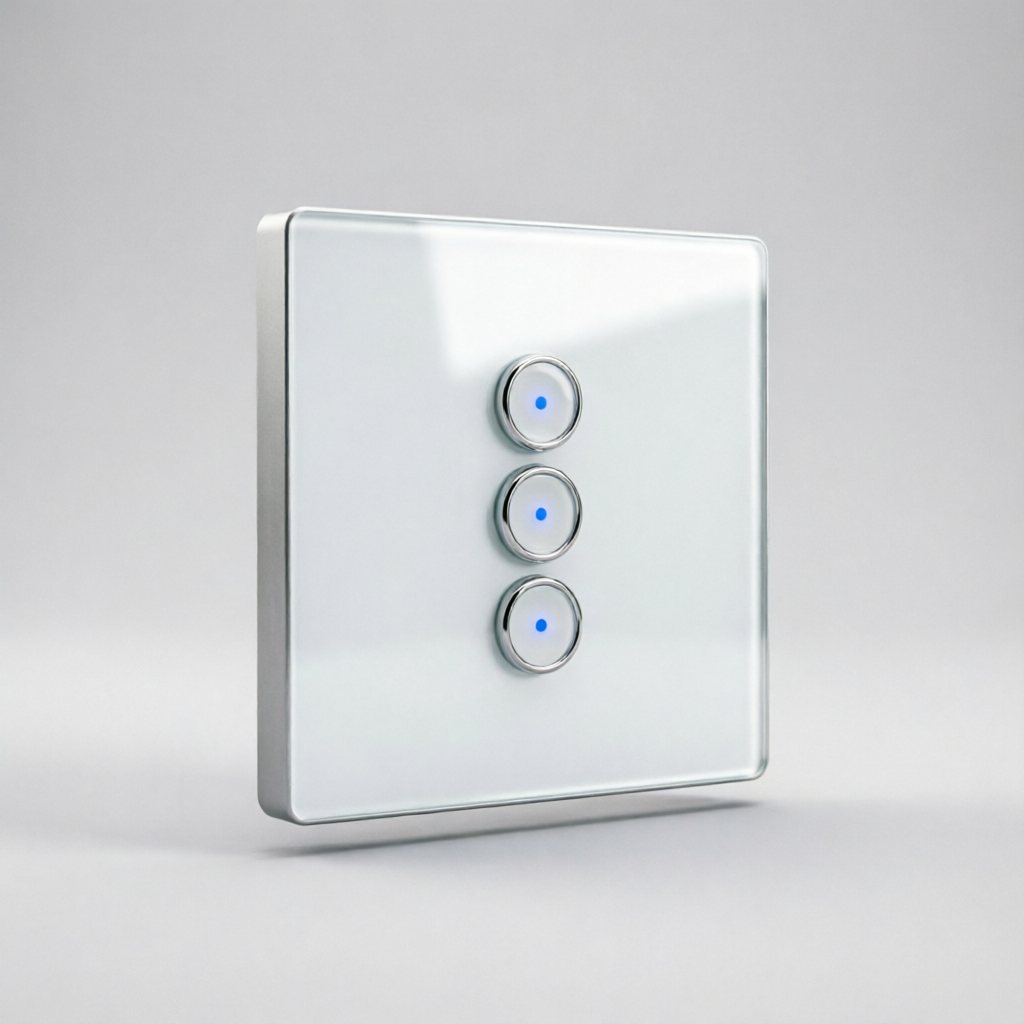
Ask a buyer why they chose a glass-front switch over a plastic one and the answer is rarely technical — it is "it looks and feels premium." Ask a factory why glass costs more to produce and the answer is entirely technical: tempering, edge-finishing and breakage risk in transit all sit upstream of that feel. Both sides of this conversation matter for an RFQ, because panel material affects unit cost, packaging requirements and which market segment a SKU is credible in.
The two materials are not simply "premium" and "budget" labels attached arbitrarily — they behave differently under the specific stresses a wall switch faces over its working life: repeated finger contact in the same spot thousands of times, exposure to cleaning products in commercial settings, and in some climates, temperature swings between an air-conditioned interior and direct sun through a window. A buyer choosing between the two materials for a specific project is really choosing which of those stresses matters most for that installation, not just which one looks better in a showroom photo.
Tempered glass: what buyers notice
- Perception: reads as premium on a showroom wall; preferred for hotel and high-end residential projects where the switch is a visible finish item, not a hidden utility.
- Feel: cool to the touch, consistent capacitive response across the surface, better resistance to scratching over years of use.
- Trade-offs: heavier, more fragile in transit (packaging and carton design matter more), and typically a longer production step (tempering, edge polish) before assembly.
PC / plastic panel: where it wins
- Perception: reads as functional rather than premium — fine for budget residential, rental units, and back-of-house commercial installs where the wall finish is not a selling point.
- Feel: lighter, warmer to the touch, more forgiving of minor impact without shattering.
- Trade-offs: can show scratches and yellowing over years of UV/heat exposure faster than tempered glass; texture and colour-matching across a batch needs tighter QC.
Cost and perception: the trade-off in one table
| Factor | Tempered glass | PC / plastic |
|---|---|---|
| Relative unit cost | Higher | Lower |
| Shelf/market fit | Hotel, premium residential, showroom | Budget residential, rental, back-of-house |
| Packaging/freight sensitivity | Higher — breakage risk | Lower |
| Long-term surface wear | Better resistance | More visible over years |
| Colour/finish options | Limited palette, glossy/matte | Wider colour range possible |
Where gang configuration and panel material interact
Panel material choice is not independent of layout — larger multi-gang plates in glass add weight and breakage risk that a 1-gang plate does not carry, which is one reason many ranges default to plastic for 4-gang and above and reserve glass for 1- to 2-gang premium SKUs. The companion gang configuration guide covers how gang count and wiring interact separately from material.
Manufacturing angle
Both panel types are produced across the same manufacturing clusters that supply most of this category — Guangdong (Shenzhen/Dongguan) for electronics-dense assembly and Zhejiang (including Wenzhou) for hardware and component supply chains. A factory that runs both tempering lines and injection moulding in-house, rather than subcontracting one, tends to hold tighter tolerance on colour-matching and edge finish across a mixed order. Ask about this directly when sourcing a mixed-material range — see the product catalogue for how SKUs are organised by material.
A note on maintenance and cleaning
Commercial buyers — hotels, offices, retail fit-outs — often underweight cleaning chemical resistance when comparing panel materials. Housekeeping teams frequently use the same all-purpose cleaner on a switch plate as on surrounding tile or paintwork, and repeated exposure to stronger solvents can dull a PC panel's finish faster than it dulls tempered glass. This is a minor factor compared with upfront cost, but worth raising with any buyer specifying switches for a hospitality project where housekeeping protocols are already fixed and unlikely to change for the sake of a switch plate.
RFQ checklist
Specify panel material per SKU (not just "premium" or "standard"), gang count, target market (to flag whether glass breakage risk needs reinforced packaging for that freight lane), and finish/colour requirements. If you are quoting a mixed glass-and-plastic range in one shipment, say so — packing and cushioning specs differ enough that combining them without notice can affect freight quotes. For hospitality and other high-touch commercial projects, also flag expected cleaning protocols so the trading desk can advise on finish durability alongside material choice.
Building a mixed-material range?
Tell us the split between premium and standard tiers you need, and our trading desk will confirm packaging and lead time based on your spec.
Start RFQWhich Rooms Get Which Face: A Practical Split
The glass-versus-plastic decision rarely needs to be all-or-nothing. A workable pattern across most portfolios: glass faces where the plate is touched and seen — living areas, hotel rooms, lobbies — and quality polycarbonate faces where function dominates — utility rooms, corridors, back-of-house, and any budget tier where the price ceiling is real. This split matches how buyers actually experience the product: the perceived-quality gap matters most where a guest or homeowner touches the plate, and matters least behind a door.
The split also manages risk. Glass delivers the premium look but carries breakage and edge-finish considerations in transit and on site; polycarbonate delivers toughness and cost but caps how premium the product reads. Carrying both in one range lets distributors answer different tenders without a second supplier, provided finishes match across faces — which returns to color masters and sample locks. When you brief the RFQ, state the split as part of the specification, not as a later decision; suppliers quote glass and polycarbonate lines with different structures, and a mixed order quoted as one often hides the worse of the two sets of assumptions.
Whatever the split, keep the touch experience consistent across faces. A household or hotel mixing glass and polycarbonate plates should not feel a different press behavior wall to wall — the factory can tune actuation to match, but only if asked at specification. Put one line in the RFQ: identical touch feel across both face materials. It is a testable sentence on samples, it costs nothing to state, and it is the difference between a range that feels engineered and a range that feels assembled from whatever was in stock. Our panel materials hub and the PC & acrylic materials page turn this split into a per-SKU specification.