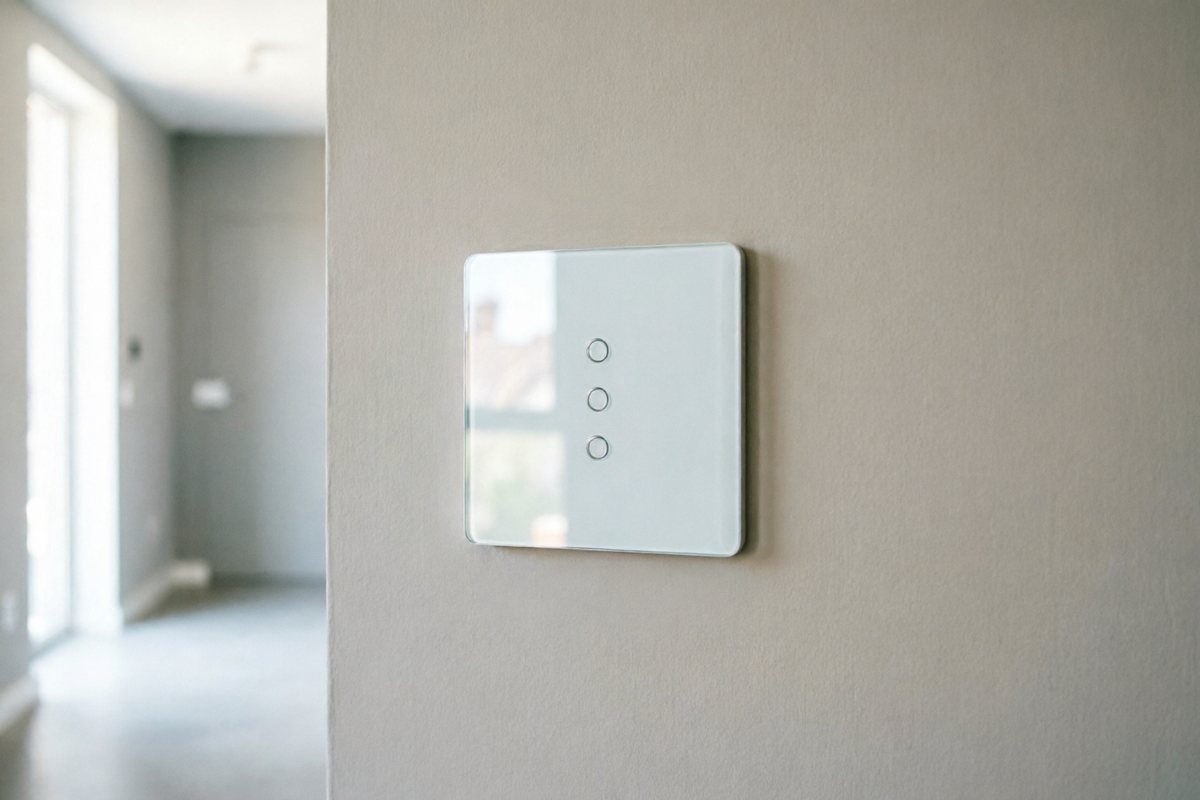
A wall switch sits inside a wall cavity, next to live wiring, often behind curtains or furniture, running unattended for years. If something goes wrong electrically, the housing and internal layout are what decide whether the fault stays contained or becomes a fire. For B2B buyers this is not an abstract concern — it is a due-diligence item that belongs in factory audits and RFQ questions, not something to assume is "handled" because a unit carries a CE mark. This guide covers the practical design and material checks worth asking about.
Housing material flammability class
Plastic enclosures for electrical switches are typically rated against a flammability standard (commonly referenced as UL 94 in factory datasheets, with V-0 as a frequently cited class for parts near live circuitry) — meaning the material is formulated to self-extinguish quickly rather than sustain a flame if it does ignite. Not every plastic used in a consumer product carries this rating; some cosmetic-only trims are not structural or load-bearing and may use a lower-cost, less fire-resistant polymer. Ask the factory specifically which parts of the housing carry a flame-retardant rating and which do not, rather than accepting "the switch is fire-safe" as a blanket statement.
Creepage and clearance on the PCB
Creepage (the shortest path along a surface between two conductive parts) and clearance (the shortest path through air) are two of the basic layout disciplines that keep mains voltage from arcing to low-voltage control circuitry or to touchable metal parts. Underspecified creepage/clearance is a common root cause in low-cost switch designs — it can look fine on the bench and still fail under humidity or dust ingress over time, which is one reason environmental aging testing (see our companion article on aging and burn-in testing) matters alongside static design review.
| Design area | What it controls | Buyer-facing question |
|---|---|---|
| Housing material | Flame spread if ignition occurs | What flammability rating, and which parts does it cover? |
| Creepage/clearance | Arcing risk between mains and control circuit | Was PCB layout reviewed against relevant spacing tables? |
| Relay/component derating | Heat build-up under sustained or peak load | Is the relay derated below its absolute maximum for continuous use? |
| Terminal/wire clamp design | Loose-connection heating at the screw terminal | What clamping method, and is torque specified for installers? |
| Internal fusing/protection | Fault current cutoff before overheating | Is there a fuse or PTC element, and at what threshold? |
Relay and component derating
A relay rated for a maximum current on its datasheet is not meant to be run continuously at that absolute ceiling — sound design practice derates it, typically running the part well under its rated maximum in the actual application to leave thermal headroom. Under-derated designs can run hot enough over months of use to accelerate insulation aging or, in a worst case, contribute to a fault. This is closely tied to the amp-rating questions covered in our amp rating guide — the continuous current a factory states on a datasheet should already reflect sensible derating, not the component's theoretical maximum.
Terminal and wiring connection quality
A loose screw terminal is one of the most common real-world causes of overheating in wall switches, independent of how well the PCB or housing was designed — resistance at a loose connection generates localised heat that a well-designed switch cannot fully compensate for. Buyers should ask what terminal/clamp system a factory uses (screw terminal, spring-cage, or similar) and whether installer torque or insertion guidance is documented, since this is as much an installation-quality issue as a product-design one.
Where certification fits
Formal certification (CE, UKCA, FCC narrative, or market-specific marks) validates a sample against a defined standard, but it is a snapshot — it does not replace ongoing production consistency. Fire-safety-relevant checks like flammability class and creepage/clearance are typically covered within the relevant safety standard's test scope, so a genuine certification report is a reasonable proxy for these items having been reviewed at least once. See our certifications page for what a report should actually specify, and treat it as one input among the design and testing questions above, not a substitute for asking them.
Touch panels and capacitive glass add their own considerations
Glass touch-panel switches introduce a design layer that mechanical rocker switches do not have: an adhesive bond between the glass and the underlying circuit, and a capacitive sensing layer that must remain electrically isolated from mains-side components. Poor adhesive quality can allow moisture ingress over years of use in humid climates, which is a slower-developing risk than an acute electrical fault but still relevant to long-term reliability in tropical or coastal markets. Buyers sourcing for such climates should ask whether the glass-bonding process and adhesive spec have been validated for the target humidity range, rather than assuming a temperate-climate design transfers without changes.
Why this belongs in factory audits, not just paperwork review
Certification reports and datasheets describe a sample at a point in time; whether the same design and material discipline holds across every production batch is a manufacturing-process question, not a document question. Buyers placing recurring or large-volume orders benefit from either an in-person factory audit or a qualified third-party inspection that specifically checks incoming plastic resin batches against the stated flammability grade and spot-checks PCB assembly against the reviewed layout — rather than relying solely on the original certification sample matching what actually ships months or years later.
RFQ questions worth asking directly
- Housing flammability rating and which components it covers.
- Whether PCB layout has documented creepage/clearance review, not just a general compliance claim.
- Relay/component derating margin versus datasheet maximum.
- Terminal/clamp type and any installer torque guidance provided with the product.
- Whether burn-in/aging testing is run on production batches (see our related article) as an ongoing check beyond one-time certification.
Auditing a new factory relationship?
Send us the SKU and target market and our trading desk will help you frame the fire-safety and design questions for that specific factory's documentation.
Start RFQ