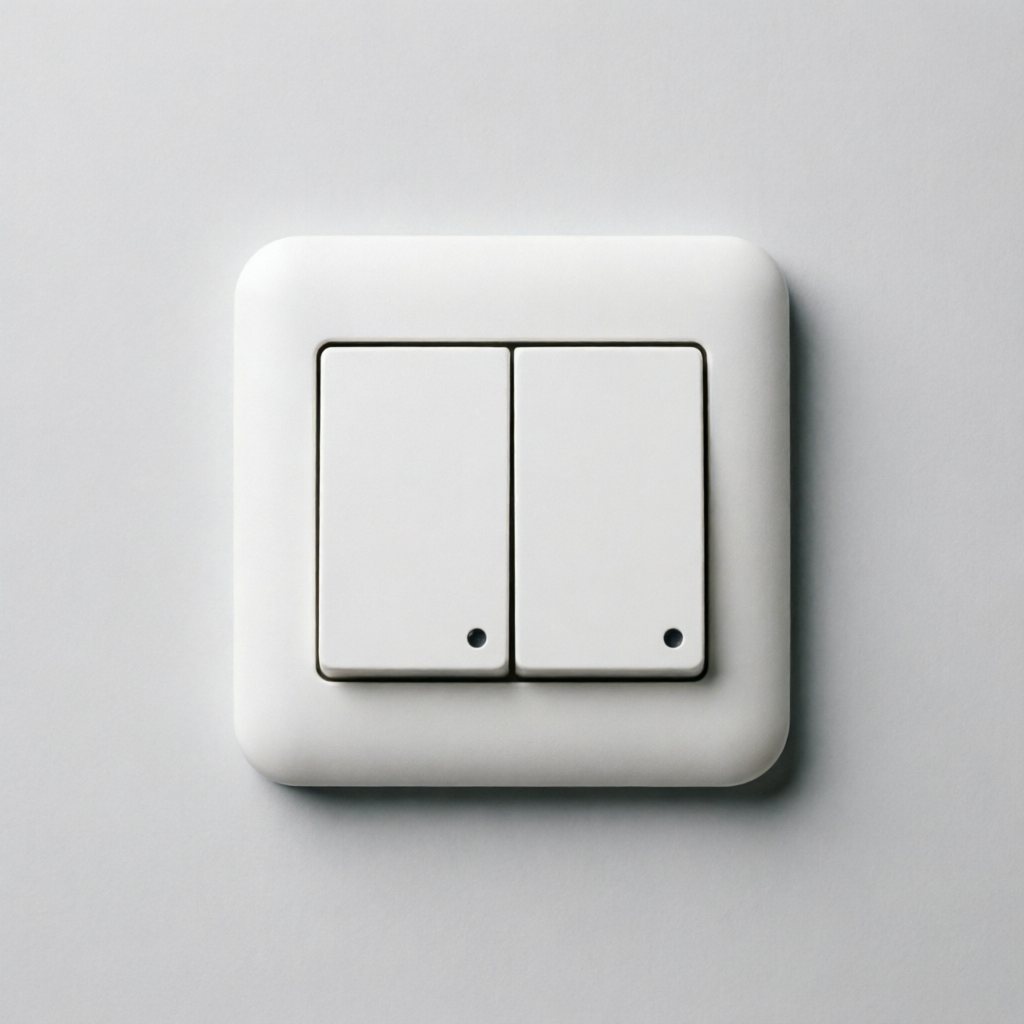
A smart switch's radio module, relay and firmware can be nearly identical across markets — the frame and wall box standard is usually what actually differs from country to country, and it is the single most common reason an otherwise correct order fails at install. Frame type determines physical dimensions, mounting screw spacing, and how many gangs fit in one box. Getting this wrong means a switch that is electrically fine and physically useless on site.
86-type: the dominant standard across China and much of Asia
- Box shape: Roughly square, 86mm x 86mm faceplate footprint — the name comes directly from this dimension.
- Gang capacity: Commonly holds 1-4 gangs within one 86mm frame, depending on module width and manufacturer design.
- Where it dominates: Mainland China, and widely exported to Southeast Asia, the Middle East and parts of Africa and Latin America where 86-type has become a de facto standard through import volume rather than formal local code.
EU (60mm round / flush-mount) standard
- Box shape: Round, roughly 60mm diameter flush-mount box, the standard across most continental European markets.
- Gang capacity: Typically 1 gang per box; multi-gang installs use multiple round boxes side by side under a shared decorative frame, rather than one wide box.
- Where it dominates: Germany, France, and most continental EU markets, with some national variation in frame brand ecosystems.
US standard (2x3 rectangular box)
- Box shape: Rectangular, taller than wide, sized to the US NEMA-style device box.
- Gang capacity: Single-gang boxes are standard; multi-gang uses wider "gang box" plates ganging multiple single boxes horizontally.
- Where it dominates: United States and Canada, with FCC-focused certification requirements layered on top — see our certifications page for how this interacts with radio approvals.
UK standard
- Box shape: Rectangular, similar footprint family to US but with different screw spacing and depth conventions; UK also has its own plate size conventions (e.g. 3x6 grid plates for multi-gang).
- Gang capacity: Wide range of multi-gang plates available as a standard part of the UK market's decorative switch culture.
- Where it dominates: United Kingdom and several Commonwealth-influenced markets, sometimes alongside CE/UKCA dual marking considerations discussed in our certifications coverage.
Frame family compatibility at a glance
| Frame family | Box shape | Multi-gang approach | Primary markets |
|---|---|---|---|
| 86-type | Square, 86mm | Single wide frame, up to ~4 gang | China, broad export markets |
| EU round | Round, ~60mm | Multiple round boxes under one decorative frame | Continental Europe |
| US rectangular | Rectangular, NEMA-style | Gang boxes side by side | US, Canada |
| UK rectangular | Rectangular, UK dimension standard | Wide decorative multi-gang plates | UK, Commonwealth-influenced markets |
Why this matters more than it looks like on a spec sheet
Frame family is often treated as a footnote in an RFQ ("EU version please") when it should be treated as its own line item alongside gang count (see our single-gang vs multi-gang guide) and wiring pattern (see our no-neutral explainer). The same electronics module can sometimes be re-housed across frame families by the factory, but not always — depth constraints for the Wi‑Fi or Zigbee module, especially in the shallower EU round box, can force a redesign rather than a simple faceplate swap. Always confirm frame compatibility explicitly with the sourced factory rather than assuming a module that fits 86-type will drop into an EU round box without changes.
For multi-market distributors, it is common to standardise the internal electronics module across frame families and vary only the faceplate and mounting frame — ask the factory whether this is how their line is engineered, since it materially simplifies stocking and reduces the number of truly distinct SKUs you need to manage.
Sourcing for more than one frame market?
List your target frame standards in the RFQ and our trading desk will confirm which SKUs share an electronics module across frame families.
Start RFQFrame Standards as a Market-Entry Decision
Frame standard is not a detail of the product; it is a decision about which market you are entering, because the wall box behind the plate is fixed by the buildings. One standard dominates China, much of the Middle East, and sizable parts of Asia and Latin America; European rounds and boxes rule most of continental Europe; US and UK devices replace that region's specific mechanisms and boxes, each with its own wiring traditions. Choosing a frame is choosing a construction stock — the installed base your product must fit into — and the choice should follow your market map, not your supplier's catalog convenience.
Multi-frame ranges are common but should be deliberate: each additional frame multiplies SKUs, spares, packaging variants and often certification scope. The practical sequence for a new distributor is one frame for the core market, evidence-driven expansion into a second frame when orders from the second market justify the carrying cost. When you brief the RFQ, state the destination country and the building stock, not just the frame name — suppliers know which frame their market's buildings actually use, and a desk handling multi-market orders will confirm the frame against real building stock rather than against a map guess, which has saved more than one container from the wrong back boxes.
A visual reference closes the frame question: keep a labeled sample board of the frame standards you sell — one plate per standard, labeled with market and box type — in your meeting room and your photographs. Buyers new to the category point at plates faster than they read standards, and the board prevents the classic cross-market quote error that text descriptions allow. The board costs one sample set; it answers the frame question for every meeting that follows, and it quietly announces that your range treats standards as seriously as its future customers do.