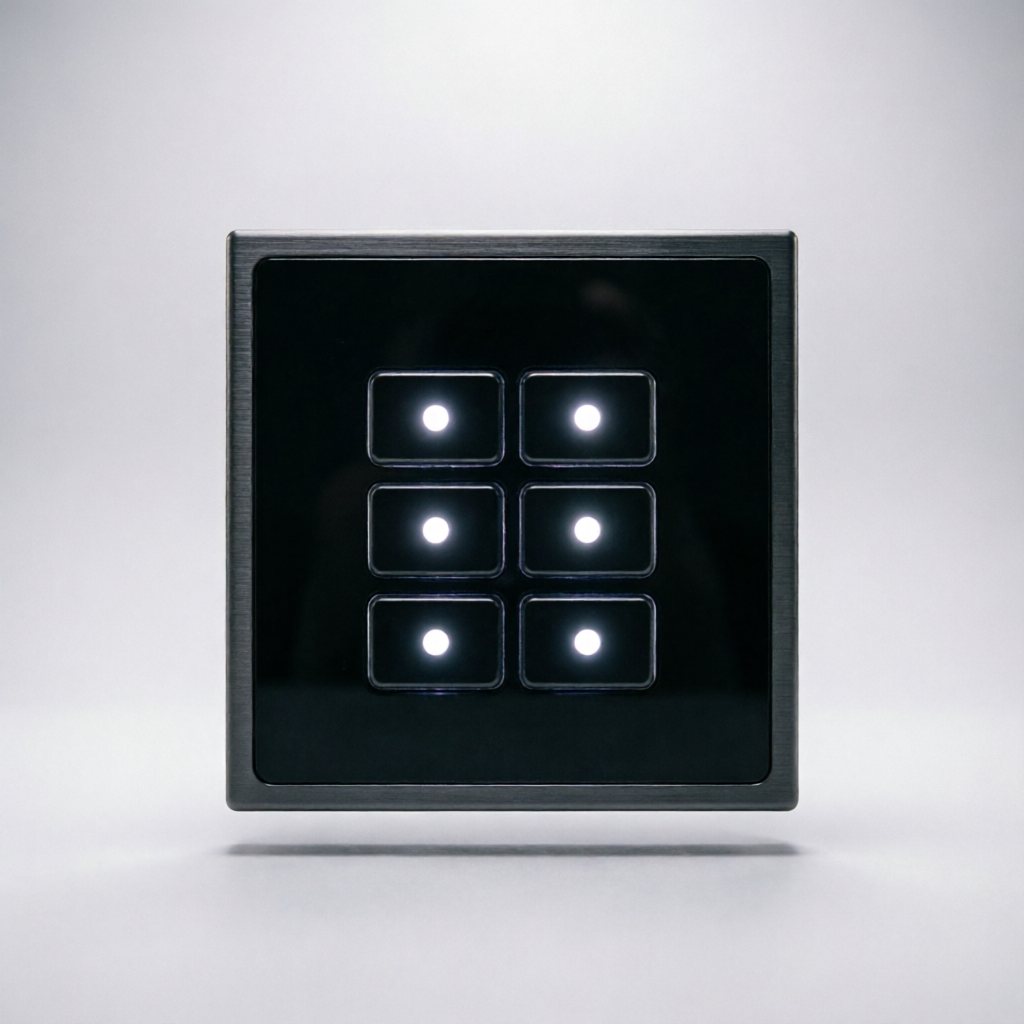
"Gang" is one of the most quietly important words in a switch RFQ. It refers to the number of independent switching circuits a single faceplate controls — one gang, one circuit — and the count changes everything from box compatibility to relay layout to app UI. Buyers who spec gang count loosely, or assume one universal SKU covers a whole project, tend to discover the mismatch only when the boxes are already in the wall.
Single-gang: flexible, but multiplies faceplates
- Pros: Fits the smallest, oldest wall boxes; simplest relay and firmware design; easiest to source in volume across many factories; lowest per-unit cost.
- Cons: A room with three circuits needs three faceplates (or a multi-gang frame holding three single modules) — more SKUs, more install labour, less clean wall aesthetics.
- Typical use: Corridors, single-load rooms, retrofit projects where box size is the binding constraint.
Multi-gang: fewer faceplates, more design constraints
- Pros: One faceplate controls 2-6 circuits — cleaner wall aesthetics, fewer SKUs to stock per room type, often preferred in hospitality and new-build residential.
- Cons: Needs a wider or deeper wall box (86-type multi-gang or a dedicated frame); relay density and heat dissipation matter more; a single faceplate failure takes multiple circuits offline at once.
- Sample SKU: PL-PN-SC6-WIFI (6-button Wi‑Fi scene panel — the multi-gang extreme, common in hotel rooms and living-room scene control)
Matching gang count to the wall box, not the room
| Box / frame type | Typical max gang | Notes |
|---|---|---|
| 86-type single box (China/Asia common) | 1-3 gang in one 86mm frame | Confirm depth for Wi‑Fi module clearance |
| EU 60mm round box | 1-2 gang typical | Multi-gang usually needs a wider frame plate |
| US 2x3 box / UK 3x6 box | Varies by frame series | See our frame types guide |
| Scene panel frame (dedicated) | 4-6 button zones | Not a "switch" in the traditional sense — button-to-scene mapping, not one relay per gang |
Where multi-gang buyers get caught out
A 4-gang faceplate does not automatically mean 4 independent relays rated for full load each — some multi-gang designs share a neutral bus or de-rate total combined load across the gangs. If the project has any high-draw circuit (water heater relay, motor load) mixed with lighting circuits on the same faceplate, ask the factory for the per-gang and combined load rating explicitly, not just the headline "gang count". This is also where scene panels diverge from switches: a 6-button scene panel like PL-PN-SC6-WIFI maps buttons to programmed scenes rather than switching six independent circuits directly — useful for hotel rooms and living rooms, but the wrong choice if the buyer actually needs six separately switched loads.
Aesthetics and wall layout planning
Beyond circuit count, gang decisions shape how a room's walls actually look once installed. A hallway with three separate single-gang faceplates spaced across a wall reads very differently from one 3-gang faceplate in the same spot — the multi-gang option is almost always preferred where wall space and box placement allow it, which is part of why new-build residential and hospitality projects lean multi-gang by default. But this preference has to be checked against actual box placement early in a project, since retrofitting three separate single-gang boxes into one wider multi-gang opening after walls are finished is a real construction cost, not a small change. Buyers working with an architect or interior designer on a new-build project should raise gang count and faceplate layout at the electrical rough-in stage, well before switch SKUs are finalised, so the wall boxes are sized correctly from the start rather than being a source of last-minute compromise.
Relay density and heat considerations at higher gang counts
As gang count rises, more relays (or more phase-cut dimming circuits) sit inside the same enclosed wall box, and heat dissipation becomes a real engineering constraint rather than a theoretical one. A well-designed 4-6 gang faceplate accounts for this in its thermal layout and combined load rating; a poorly designed one simply multiplies single-gang design without adjusting for the shared enclosed space. This is one of the less visible differences between factories, and it is worth asking directly whether a high-gang SKU has been tested at full combined load in an enclosed box, rather than assuming gang count scales linearly with no design changes needed.
Planning the mix across a project
Most real projects need a mix, not one gang count everywhere: 1-gang for bathrooms and small utility rooms, 2-3 gang for bedrooms and living areas, and scene panels for hotel rooms or feature living spaces. State the room-by-room gang requirement in your RFQ rather than a single blanket number — for a multi-room fit-out this usually pairs well with our solutions page breakdown by room type, and with the hotel scene panel article if hospitality is part of the scope.
Also decide gang count before locking wiring box types with the site electrician — retrofitting a wider box after walls are closed is far more expensive than adjusting the switch SKU at RFQ stage.
Planning gang count across multiple room types?
List rooms and circuit counts in your RFQ and our trading desk will confirm which gang configurations and frame types fit, factory by factory.
Start RFQMixed-Plate Projects: Where Gang Counts Meet Reality
Real rooms mix gang counts on adjacent walls — a triple switch by the door, a single by the bed — and the mix is where sourcing details bite. Multi-gang plates have different glass sizes, deeper back box requirements in some markets, and print layouts that must align across gangs even when the load types differ. A distributor whose range mixes gangs should verify on samples that the plates read as one family on a wall: matched finishes, aligned legends, consistent spacing. The wall is the customer's first impression of your quality discipline.
For the order itself, the mixed-room pattern argues for forecasting gang mix per project type rather than per container, as covered elsewhere — but it also argues for sample approval per gang class. A two-gang approval does not automatically cover the four-gang plate's print alignment or glass dimensions from the same factory tooling family. One sample set covering each gang class in your range costs little and closes the gap between catalog photos and installed walls. A consolidating desk will run these approvals across product lines at once — switches, scene panels, sockets — so the whole wall arrives as one verified family.