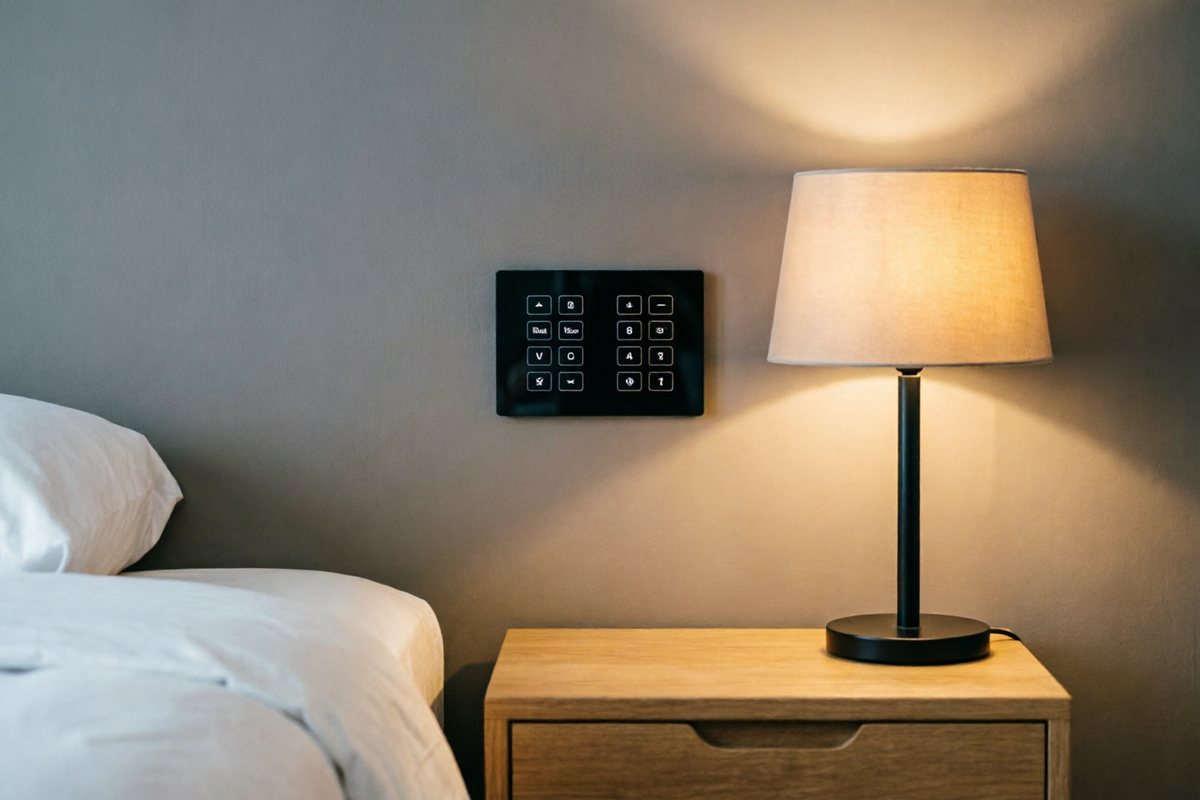
Multi-scene panels are the value anchor next to commodity wall switches: higher unit price, more engineering questions, more OEM print. Hospitality is one scene among several (apartment, office, retail) — but hotel rooms have the clearest BOM pattern, which is why this checklist uses a hotel guest room as the reference case even though the same panel family typically serves other project types too.
1. Define the room map first
- Entrance: key card power (sample PL-HT-CARD-UK class) — usually the first thing a guest touches, so pairing/response speed matters as much as the visual finish.
- Bedside: scene keypad or multi-gang (reading / master off / curtain) — the position with the most buttons and the most room for a wrong function map.
- Bathroom / corridor: status or simple switch — usually the least customised position, but still needs to match the plate family visually.
- Optional: DND / MUR indicators in the same plate family — these carry brand-specific icon sets and are one of the more common causes of late-stage art rework if not locked early.
See package structure: Hotel Guest Room Panel Kit.
2. Plate standard and visual family
UK, EU and 86-type plates do not mix silently. Lock colour (white/black), glass thickness narrative, and icon set before sampling. OEM art for DND/MUR must match brand guidelines. A single hotel brand run across multiple properties or countries often means several plate standards under one visual identity — treat "same look, different frame" as a design requirement to state in the RFQ, not something a factory will infer on its own. Bedside scene keypads are usually operated in low light, so icon contrast and tactile distinction between buttons deserve the same attention as the print artwork itself — a detail worth confirming on the physical sample, not just the render.
3. Protocol per project type
Some hotels still prefer wired or RS485 central logic; others accept Wi‑Fi/Zigbee room packs. Do not force Tuya consumer apps into a tender that names a BMS — escalate early. Where a project asks for Matter compatibility on a hospitality rollout, treat it like any other spec item: confirm the exact revision and certification status per device family before quoting, since Matter's growing device count (4,000+ certified devices as of 2026, spec v1.6 from June 2026) does not mean every hospitality-grade module in market has been certified against it.
4. RFQ fields that prevent rework
- Rooms × floors × plate standard
- Functions per position (card / scene / DND)
- Protocol and whether gateway is per floor or per building
- Logo/print files and languages on manuals
- Certs for destination country
- Sample room deadline vs mass production window
- Whether the property has one plate standard or several (multi-property rollouts)
5. Sample room first, mass production second
A disciplined hotel rollout treats the first room (or floor) as a mock-up: full function map, real plate colour, real icon art, tested against the property's actual BMS or app stack before committing to the remaining floors. Skipping this step to save calendar time is the most common reason multi-scene projects end up reworking print or function assignments mid-rollout. Exact sample and mass-production lead times vary by factory and season — confirm both in your RFQ rather than assuming a standard timeline.
6. Why multi-scene panels are quoted differently from commodity switches
A single-gang on-off switch is close to a commodity, quoted mostly on unit price and MOQ. A multi-scene panel bundles mechanical design, icon art, protocol integration and sometimes card-reader hardware into one SKU, so the RFQ has to carry more engineering detail before a factory can price it accurately. This is also where a trading desk earns its role: coordinating card-reader, keypad and gateway sourcing across a partner network — PanelLink's own network spans 40+ partner factories and 8,000+ SKUs across 50+ export markets — is materially different from asking one factory to build a component it does not normally make.
7. Spare parts and warranty planning
Multi-scene panels are harder to swap in the field than a single-gang switch, both because the plate is more visible to guests and because a scene keypad's function map is specific to its room type. Property-level procurement teams typically hold a small spare pool per floor or per room type so a faulty unit can be swapped without waiting for a new production batch, rather than sourcing spares reactively after a failure. Exact spare-parts ratios and warranty terms should be confirmed per order — they vary by project scope and are not part of any published site-wide figure.
8. Who owns the icon and language files
DND/MUR icon sets and multi-language manual text are usually supplied by the buyer's brand or design team, not invented by the factory. Projects run more smoothly when one party — buyer or trading desk — is named as the single owner of the current approved art file version, since a scene panel programme running across several properties or refurbishment phases can otherwise end up with two "final" versions of the same icon set in circulation.
9. Beyond hotels
The same panel family can serve apartment fit-out (unified look) and office meeting rooms (scene keypad + curtain). Keep the value-anchor story as multi-scene, with hotel as a flagship kit — not the only kit.
RFQ a room kit
Send room count, plate standard and scene list — we return a consolidated multi-factory quote path (sample trading narrative).
Start RFQ View sample kit