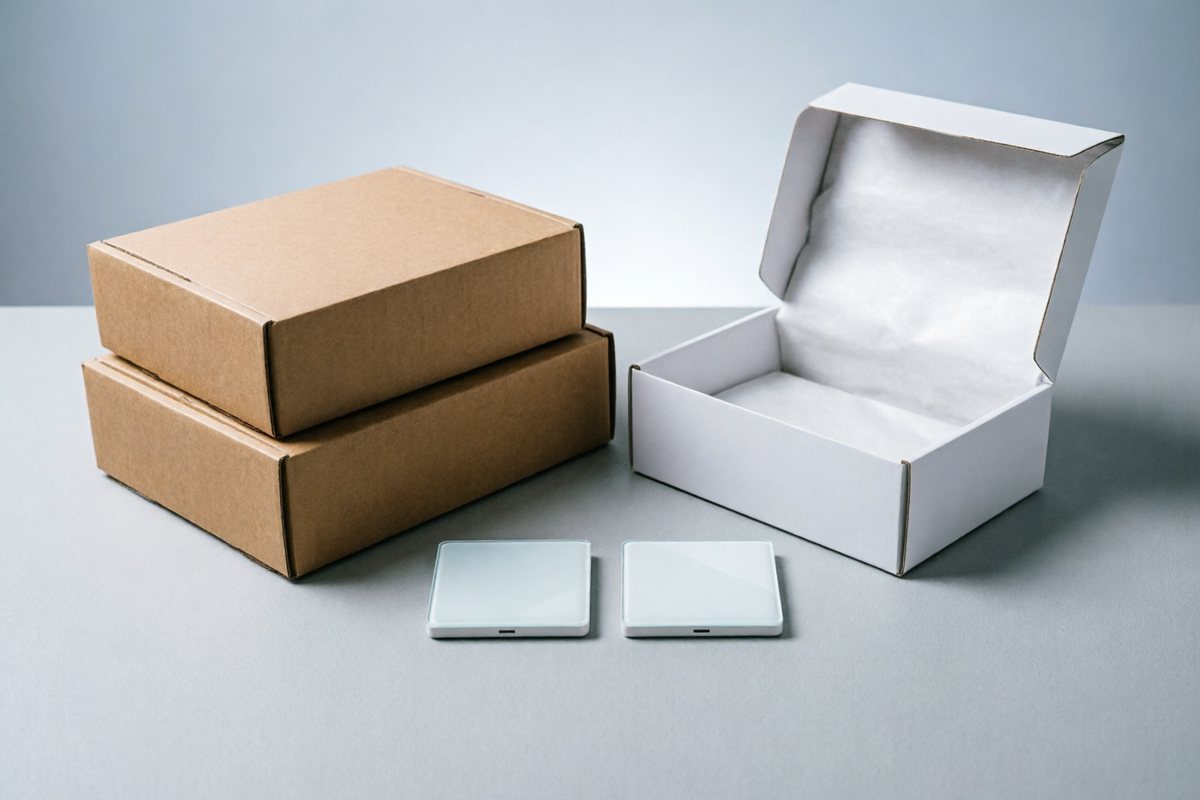
Many smart wall switches on export lines use Tuya-class modules and Smart Life pairing. OEM buyers still need a disciplined loop: brief → sample → pilot → mass. Trading suppliers add value by coordinating factories so brand, carton and cert pack stay consistent — the discipline matters more than the module choice, because most OEM rework traces back to a decision that was never written down before the sample was approved.
Checklist before sample
- Logo files (vector) and print method (silk / laser)
- Glass colour and backlight preference
- App: public Tuya/Smart Life vs private brand (MOQ impact)
- Manual languages and carton language
- Barcode / SKU scheme
- Target certs and destination market
- Frame standard and gang mix forecast
Public app vs private-label app — what actually changes
Running on Tuya/Smart Life as the public app is the fastest path to market: the pairing flow, cloud infrastructure and Alexa/Google bridging are already built, and the factory's main integration work sits on the hardware and firmware side. A private-label app changes the commercial shape of the order more than the switch itself — it usually means a separate app-store listing under the buyer's brand, a dedicated cloud project, and often a materially higher MOQ to justify that setup work. Buyers should decide this early and in writing, since switching from public app to private app mid-programme, after tooling and firmware are locked, is far more disruptive than deciding it before the first sample.
Sample approval criteria
- Pairing time and stable reconnect on 2.4 GHz test AP
- Touch feel and LED brightness
- Print registration and scratch resistance narrative
- Packing drop test photo if required by retailer
- Function map matches the brief exactly — gang order, icon set, and dimmer/fan behaviour if applicable
- App pairing tested under the correct brand (public vs private) rather than a generic test account
AQL and inspection basics for a first OEM order
Before mass production starts, agree what "pass" means in writing: an AQL (acceptable quality level) sampling plan for the batch, which defects count as critical vs minor, and at which stage inspection happens — during production, before packing, or both. For a first OEM order, a pre-shipment inspection with photo checkpoints is worth the extra step even on a modest quantity, because it is far cheaper to catch a print-registration or function-map error at the factory than after the container has sailed. Whether third-party inspection is included, and its exact timing relative to vessel cut-off, should be confirmed per order — factories and trading desks vary in what they include by default.
Mass production controls
Agree AQL, photo checkpoints, and whether third-party inspection is booked before vessel cut-off. Multi-factory orders need one packing list standard so the brand does not look fragmented at destination.
What to keep after sample approval
Once a sample is approved, the paper trail matters as much as the physical unit. Buyers should retain a signed spec sheet (frame, gangs, protocol, app, print files, cert targets), dated photos of the approved sample from multiple angles, and ideally a physical "golden sample" kept on the buyer's side for reference during mass-production inspection. Multi-factory or multi-season programmes benefit most from this discipline, since a verbal understanding from months earlier is much harder to enforce at inspection time than a signed reference document.
Typical failure points on a first OEM order
- Logo colour or print method approved on a proof but not matched exactly on the production run.
- Manual language list agreed verbally but not written into the PO, causing a mismatch at packing.
- Public-app pairing tested in the sample round, then the programme later asks for a private-label app without re-testing pairing under the new brand.
- Different factories in the same programme using slightly different carton artwork or barcode schemes without one shared standard.
- Certification targets agreed for one destination market, then the same SKU shipped to a second market without re-checking whether the same certs apply there.
Sequencing a multi-factory OEM programme
Where switches, sensors and a gateway all carry the same brand, it rarely makes sense to force one factory to build all three — most factories specialise. A workable sequence is to approve each product line's sample independently against the same brand spec sheet, then align packing, cert-pack format and shipping schedule centrally once all lines are approved, rather than waiting for every factory to finish before checking any of them. This is the coordination role a trading desk is built around, distinct from simply forwarding a PO to a single factory.
Cost drivers buyers often overlook
Private-label programmes are usually compared on unit price, but two line items get missed more often than they should: tooling or print-plate cost for a new logo/colour combination, and the cost of re-testing pairing and certification if the app brand or protocol changes after the first sample round. Neither is exotic — both are standard parts of an OEM programme — but neither shows up in a unit-price comparison sheet, which is why they belong in the written brief rather than being discovered at invoice stage.
When to consolidate versus split factories
Consolidating an entire brand's product range onto one factory can simplify communication, but only where that factory genuinely covers every category well; forcing a single factory to build outside its core competence to keep the order "simple" is a common source of quality issues. Splitting across factories by category, coordinated through one trading desk, usually protects quality better than false consolidation — provided packing and cert-pack formats are still unified.
Why a trading desk matters for multi-factory OEM programmes
An OEM programme rarely stays inside one factory once it grows past a single SKU — switches, sensors and gateways are frequently built by different specialists. A trading desk that already coordinates a partner network can hold one packing standard, one cert-pack format and one point of contact across factories; PanelLink's own sourcing network, for reference, spans 40+ partner factories and 8,000+ SKUs across 50+ export markets with a 95% on-time shipment record and 12 years in export. Any partner claiming similar reach should be able to show comparable structure, not just a comparable price.
More process detail: OEM / ODM page. Product example: PL-SW-T3-WIFI-86.