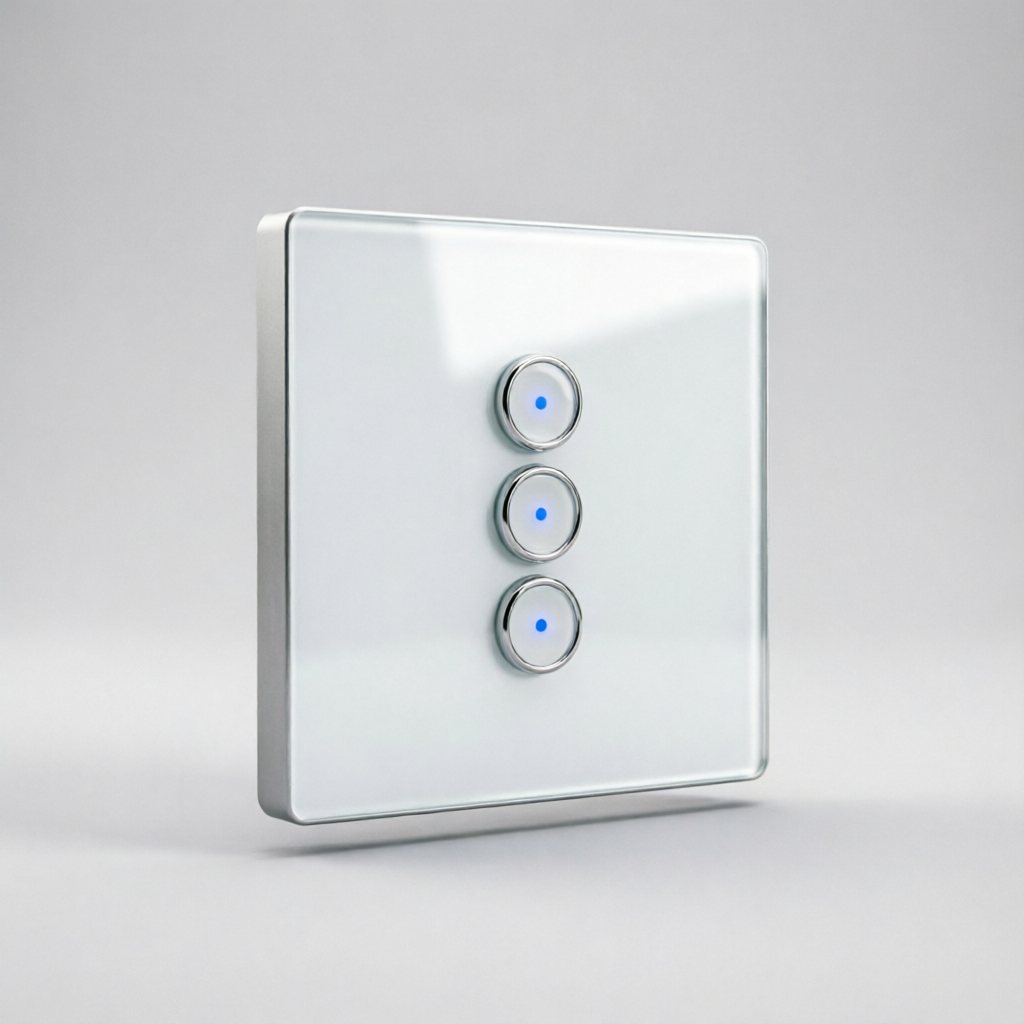
Panel face material is one of the few specs a buyer's end customer can actually feel and see, which makes it a bigger deal commercially than its line-item cost suggests. The two dominant choices — tempered glass and polycarbonate (PC) — trade off in almost opposite directions: glass wins on premium feel and scratch resistance, PC wins on impact tolerance and shipping economics. Neither is universally "better"; the right one depends on where the switch is going and how it will be handled between factory and wall. For the material-by-material view, see our panel materials section, starting with the dedicated tempered glass panels page.
Tempered glass: premium feel, brittle under point impact
- Pros: Cold, dense, premium tactile feel; excellent scratch resistance for daily wipe-down cleaning; takes silk-screen and printed icon finishes well; the material most touch switches are built around, since capacitive sensing was largely designed for glass fronts.
- Cons: Brittle failure mode — a hard point impact (dropped tool during install, a hard knock) can shatter rather than dent; heavier, which raises freight cost marginally at volume; breakage in transit is a real line item to plan packaging around, not a theoretical risk.
- Typical fit: Showroom-facing residential and hospitality installs where scratch resistance and premium feel matter more than impact risk during rough handling.
Polycarbonate (PC): tougher in transit, softer over years
- Pros: High impact resistance — flexes rather than shatters under a knock, which matters both for shipping breakage rates and for rough job-site handling before final install; lighter, marginally cheaper to freight; lower unit cost.
- Cons: Softer surface scratches more easily over years of contact, especially with keys or abrasive cleaning; can show more visible wear on dark, glossy finishes than glass does; some buyers perceive it as a lower-tier finish regardless of actual performance.
- Typical fit: Cost-sensitive rocker lines, high-volume commercial corridors, and any project where shipping breakage risk outweighs showroom photogenic value.
Side-by-side on the metrics that matter to a buyer
| Metric | Tempered glass | Polycarbonate (PC) |
|---|---|---|
| Scratch resistance | High | Moderate — wears over years |
| Impact tolerance | Lower — brittle failure | Higher — flexes, resists cracking |
| Perceived premium feel | Higher | Lower, though closing gap with good finishes |
| Shipping breakage risk | Needs careful packaging | Lower, more forgiving |
| Typical relative unit cost | Higher | Lower |
What this means for packaging and claims
If you are sourcing a glass-face line for a market with long transit times or multiple handling transfers, ask the factory specifically about their glass packaging spec — foam density, box compartmentalisation, and whether they have a documented breakage rate they are willing to state. This is not a number PanelLink invents on their behalf; state your route and transit time in the RFQ and let the sourced factory confirm their packaging spec and any claims process directly. For rugged or outdoor-adjacent applications, also check our IP rating guide, since impact resistance and ingress protection are often specified together in the same project brief.
Matching face material to the rest of the spec
Face material interacts with sensing type — most capacitive touch switches are engineered around glass, so switching a touch line to PC is not always a simple swap without controller recalibration (see our piece on how capacitive touch panels work). Mechanical rocker switches, by contrast, are commonly offered in PC as standard, which is part of why the rocker segment tends to sit at a lower price point overall. If your catalogue spans both touch and rocker lines, it is worth deciding face material and sensing type together in the same RFQ conversation rather than sequentially.
Weighing glass vs PC for your next shipment?
Tell us your transit route and handling conditions in the RFQ and our trading desk will confirm packaging specs with the sourced factory.
Start RFQEdge Finish and Printing: Where Faces Actually Differ
The face material debate usually stops at glass versus plastic and misses the two details buyers actually see after installation: edge treatment and print behavior. Tempered glass edges arrive ground or polished; polished edges read premium and survive handling, ground edges catch light and fingertips. Polycarbonate faces vary in surface hardness class — a harder coating resists the micro-abrasion that makes plastic look tired within a year. Neither detail costs much at specification; both are expensive to discover in a guest corridor under downlighting.
Printing interacts with material too. Glass carries silk-screen printing behind the surface — durable, but with visible register considerations around cutouts — while polycarbonate prints on the surface, offering finer detail with lower scratch headroom. Multi-color logos, fine icons and gradient effects each favor a different material-process pair, so the artwork should be part of the material decision rather than applied after it. Request face-material samples with your actual artwork printed when the branding matters, and lock both the material and the print process in the sample approval. The desk consolidating across product lines will also match edge and print treatment across glass and polycarbonate parts in the same range, which is the detail that makes a mixed range read as one brand.
The material decision also deserves a seasonal revisit rather than a permanent verdict. Glass and polycarbonate supply prices move independently, surface-coating technology advances yearly, and the market split itself shifts with design fashion. The distributor who re-quotes the material split annually — same specification, current prices, fresh samples — captures the movement as margin or as competitiveness, while the one who decided once in the past pays whatever the original decision costs today. Materials are the most revisit-friendly line in the range because the decision is cheap to reopen and the spread is too real to ignore.