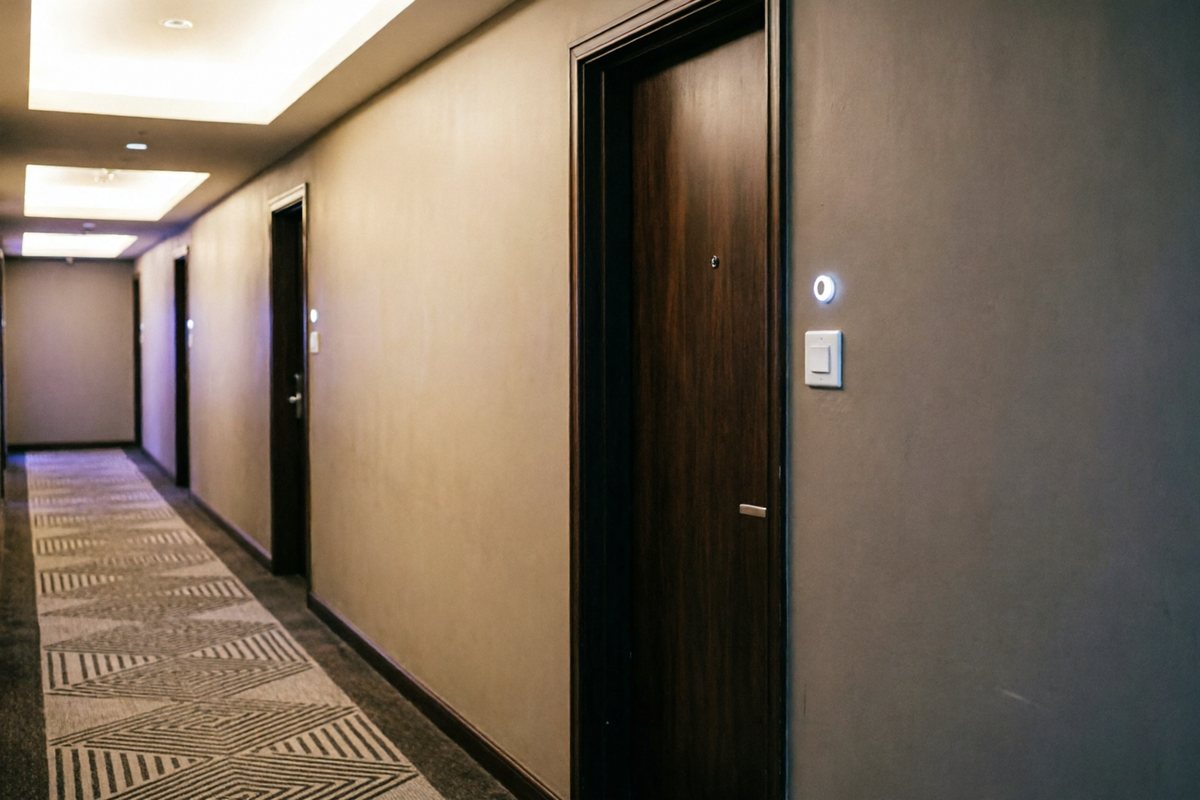
Of all the buyer segments driving the smart home category — estimated near USD 180.12 billion in 2026 and forecast to reach roughly USD 848.47 billion by 2034 — hospitality has consistently been one of the earliest and most concentrated adopters of wall control at scale. A single hotel renovation can generate an order for hundreds of rooms in one procurement cycle, which is a very different buying pattern from residential retail. This snapshot covers why hospitality moved early, what protocol reality actually looks like once you are past the sales pitch, and what a hospitality RFQ should specify.
Why hotels adopted early
Three forces converge in hospitality that do not converge the same way in residential: energy cost control at scale (occupancy-linked HVAC and lighting scenes cut operating cost across hundreds of rooms), guest experience differentiation (scene panels and key-card switches are a visible, marketable amenity), and centralized procurement (a single general contractor or hotel group can specify one system across an entire property or portfolio, rather than relying on unit-by-unit consumer purchases). This is a large part of why hotel-focused scene panel kits are one of our most requested categories — see our dedicated piece on hotel and multi-scene panel specification.
Protocol reality in hotel corridors and rooms
The pitch decks favor whichever protocol the presenter is selling; the on-property reality is more constrained. Zigbee with a per-floor gateway remains a common lean for hotels because it handles the sensor density (door contacts, PIR occupancy sensors, thermostats) better than pure Wi‑Fi in a building with many devices per floor competing for 2.4 GHz spectrum. PIR-driven occupancy automation in corridors and back-of-house areas is a frequent line item — our note on PIR sensors and occupancy-based lighting covers how that pairing actually works. Wi‑Fi remains viable for lower-density room configurations or where the property's IT policy resists managing gateways, but it needs a genuine site survey, not an assumption.
Procurement patterns distributors should expect
- Standardized room-type kits. Hotels typically specify by room type (standard, suite, corridor, back-of-house) rather than by individual device — RFQs should be structured the same way.
- Single-vendor preference within a phase. Mixing app ecosystems mid-renovation raises support cost; most hotel groups prefer one protocol and one app stack per renovation phase, even if a future phase changes standard.
- Certification documentation requested upfront. Larger hotel groups and their electrical consultants increasingly ask for certification documentation (CE, relevant RF marks) before sampling, not after.
Certification and after-sales load
Hospitality after-sales support carries a different weight than residential: a malfunctioning switch in an occupied hotel room is an operational incident, not a returned online order. This raises the bar on QC consistency and on having clear pairing/installation documentation for on-site engineering teams. Buyers should confirm certification status per market — for UK-bound projects, note that CE marking is still recognized as covering 21 key regulations as of 2026, and Northern Ireland properties require a CE mark under the Windsor Framework regardless of UKCA status. See Certifications for the fuller picture.
What a hospitality RFQ should specify
State property type and scale (rooms, floors), room-type breakdown, protocol preference and gateway tolerance per floor, sensor scope (PIR, door/window, temperature — see our related pieces on door and window sensors and temperature and humidity sensors), and target certification markets. Our Solutions page has scenario-based packages that map to common hotel configurations.
What a phased renovation typically looks like
Very few hotel groups replace every room's wall control in a single order. The more common pattern is a floor-by-floor or wing-by-wing rollout, timed to minimize the number of rooms taken out of inventory at once — a property still needs rooms to sell during a renovation. This staged approach has direct sourcing implications: rather than one large one-time order, distributors should expect a framework agreement covering a defined SKU set and pricing, drawn down in tranches as each phase is scheduled. Confirming this upfront avoids a mismatch where a factory prices for a single bulk order but the buyer actually needs staged delivery with consistent specification across each tranche, sometimes many months apart.
Why specification consistency across phases matters more than speed
Because renovations run in phases, a hotel group cares more about being able to source the identical SKU eighteen months into a multi-year rollout than about shaving a few days off any single shipment. This favors working with a trading desk that can commit to specification continuity — same module revision, same finish, same firmware behavior — across an extended rollout, rather than a one-off lowest-price quote that cannot guarantee the same product will be available for phase three. Buyers should raise this explicitly in the RFQ if the renovation is expected to run in stages over more than one budget cycle.
Sourcing for a hotel renovation?
Send room count, room-type mix and protocol preference in your RFQ; our trading desk will confirm gateway plan and certification path.
Start RFQReading the Adoption Signal as a Sourcing Opportunity
Hospitality adoption headlines are easy to over-read; the sourcing signal sits in the details. The meaningful indicators are not the flagship smart hotels but the mid-scale chains standardizing switch packages across renovations, the serviced-apartment operators specifying scene panels as standard fit-out, and the regional groups publishing supplier criteria — because standards and criteria are where repeat volume lives. A distributor watching for these signals can position stock and certification ahead of the tender cycle instead of reacting to it.
Two practical tracking habits capture the signal without a research budget. Watch renovation cycles rather than new builds — renovation volume is larger, decisions are faster, and the specification question is what replaces this rather than what should we try. And track which markets' hospitality associations publish smart-room guidelines, because guidelines precede procurement by quarters. When your range and your certifications align with a published guideline, your RFQ arrives pre-answered; a desk consolidating multi-market orders sees these guideline patterns across territories and can point your range at the nearest one.