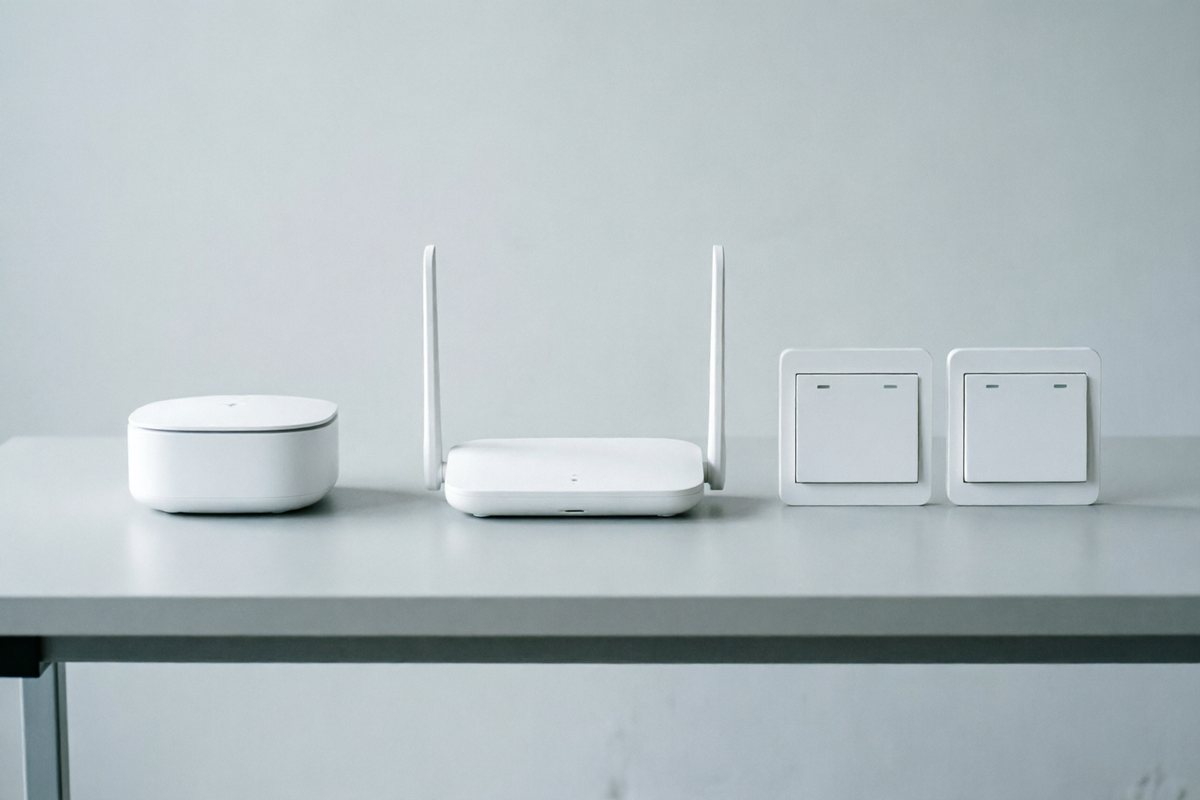
Matter is a data-model standard, not a radio — it can run over Wi‑Fi, Ethernet or Thread, and the choice of transport is where most of the practical differences for a wall switch programme actually live. "Matter over Thread" gets discussed as if it were a single feature, but for a buyer writing an RFQ it is really a question about power budget, mesh behaviour and one extra piece of infrastructure: the border router.
What Thread actually is
Thread is a low-power, IPv6-based mesh networking protocol built on the IEEE 802.15.4 radio layer — the same radio layer Zigbee uses, but with a different upper-layer protocol and native IP addressing. Because every Thread device gets a routable IP address, Matter can speak directly to a Thread device without a protocol-translation gateway in the same way it needs one for Zigbee. The trade-off is that Thread needs a border router — a device that bridges the low-power Thread mesh to the household Wi‑Fi or Ethernet network — before any Thread device can reach the internet or a phone app outside Bluetooth range.
Why Thread matters more for battery accessories than for switches
The biggest power-budget win from Thread shows up in battery-powered accessories — door sensors, PIR sensors, battery-driven scene buttons — where 802.15.4's low-power characteristics extend battery life meaningfully compared with Wi‑Fi. A mains-powered wall switch does not have the same battery constraint, so the power argument for Thread is weaker there. What still matters for switches is mesh participation: many Thread-capable switches act as router nodes in the mesh, extending range and reliability for the battery sensors around them even though the switch itself is not power-constrained. That is the practical reason a switch RFQ might specify Thread even when battery life is not the switch's own concern.
Who provides the border router
In consumer ecosystems, the border router is increasingly built into existing hub-class hardware — smart speakers and set-top boxes from Apple, Google and Amazon have been shipping with Thread border router capability as a background feature rather than a separate purchase. For B2B buyers this is a mixed blessing: it can mean the buyer's end customer already owns a border router without knowing it, but it also means the supplier cannot always guarantee one is present, and hospitality or office projects with no consumer hub ecosystem in the building will need a dedicated border router quoted as a line item.
Where this sits in the 2026 protocol landscape
Matter passed 4,000 certified devices in 2026, and specification version 1.6 was published in June 2026 with expanded device type coverage. Matter is backed by Apple, Google, Amazon and Samsung, covering more than 95% of the voice-assistant install base, which is the underlying reason Thread-capable switches are increasingly requested even outside pure consumer retail — project buyers want a device that can sit inside whichever of those four ecosystems the end customer already uses. This sits against a smart home market estimated at roughly USD 180.12 billion in 2026, projected to grow to about USD 848.47 billion by 2034, which is the scale reason protocol interoperability keeps being asked for in tenders rather than left to a single ecosystem bet.
Planning a roadmap if you already stock Zigbee
Buyers with an existing Zigbee catalogue often ask whether Thread is a replacement they need to plan a migration away from, or an addition that can sit alongside Zigbee indefinitely. In practice it is closer to the latter for now: Zigbee's certified product ecosystem, at more than 3,500 certified products, is broader than Matter's today, and Zigbee 4.0 — adding sub-GHz and SUZI support later in 2026 — shows the standard is still being actively extended rather than wound down. The more realistic planning question is which new SKUs, if any, should be built Thread-capable from the start so they have a lower-friction path into Matter ecosystems, while the existing Zigbee catalogue continues to serve buyers who are not asking for Matter compatibility. Treating this as an additive decision rather than a forced migration keeps the existing Zigbee product line's value intact while opening a second path for buyers who specifically want it.
What to specify in the RFQ
- State whether Thread border router hardware is expected to be supplied as part of the order or assumed to exist on-site.
- Ask whether the switch acts as a Thread router node (extends the mesh) or an end device only (does not relay for others).
- If the project also uses Zigbee sensors, clarify that Zigbee and Thread are different upper-layer protocols on the same radio band and will not talk to each other without a bridge, even though they share spectrum.
- Confirm which hardware revision and firmware build any Matter/Thread certification actually covers — see our companion piece on how Matter certification works for the detail.
For the wider protocol comparison, see the Protocols page; for how mixed Thread/Zigbee/Wi‑Fi orders are packaged into one shipment, see Solutions.
Planning a Thread-ready switch line?
Tell us your target ecosystem and mesh density in the RFQ — our trading desk will confirm border router and certification scope for the SKU.
Start RFQThread in Your Product Plans: What to Ask Now
Thread relevance to your order depends on three questions you can ask at quotation stage. Is the module in this SKU Thread-capable hardware, or is Thread a firmware-future claim — the distinction is silicon, and it does not arrive by update. If Thread-capable, is the stack certified today for the device category, or planned. And if buyers use Thread, does the product need a border router in the premises, which changes what else the project must include. The answers sort every wall switch line into three procurement decisions: Thread now, Thread later on the same hardware, or no Thread path.
The forward-looking habit is to leave a lane. Buyers do not need to commit to Thread to protect the option of it: choosing lines whose module family has a Thread story, keeping the RFQ's protocol field as a family rather than a single answer, and recording the module identity in the order file all preserve choice cheaply. When the market decides — and the direction in 2026 is increasingly clear — the distributor with a documented module path ships the new variant as a revision, while the one without starts a new supply chain from zero.
A closing calibration on timing: standard transitions reward neither the earliest adopters nor the last, but the informed middle. Buyers who understand what their current modules can and cannot become make calm, sequenced moves — a Matter-certified flagship line this season, Thread-capable modules in the next platform revision, the volume floor refreshed on the natural reorder cycle. The transition is a curve, not a cliff, and your order file is the instrument that tells you where on the curve each of your SKUs sits today.