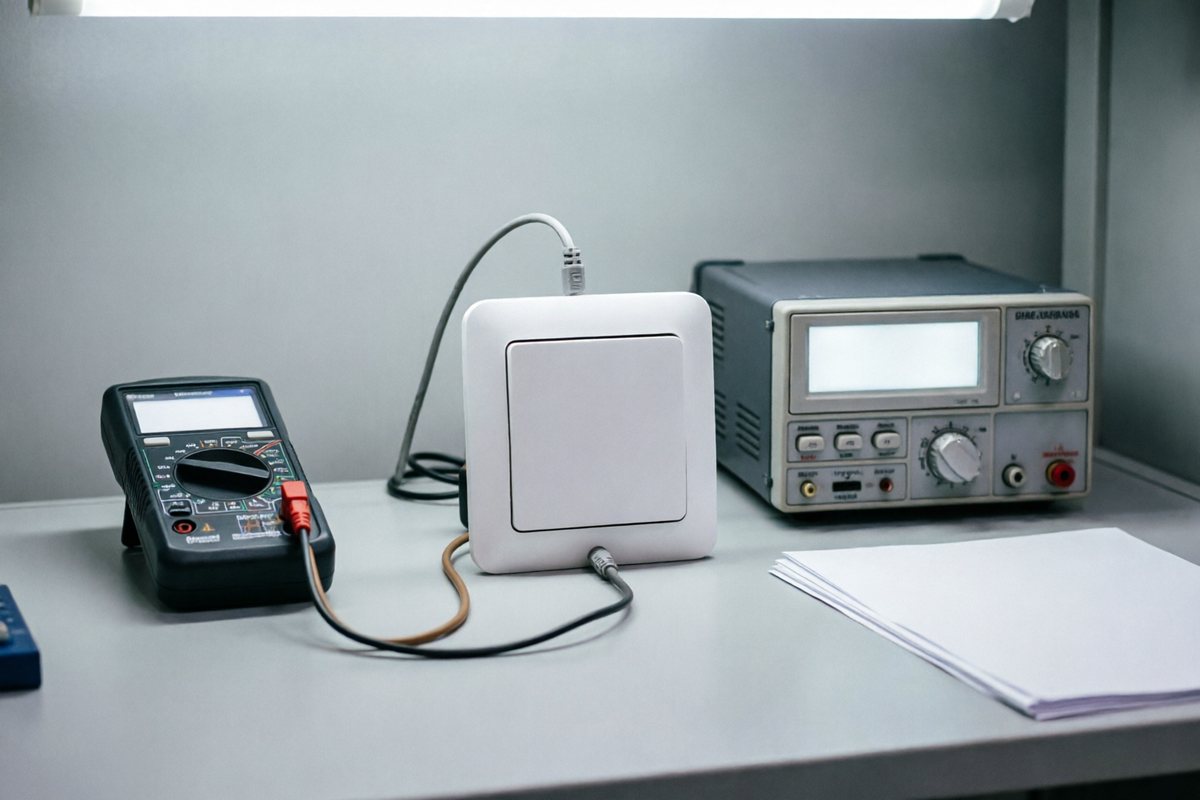
Matter is often pitched to buyers as "one certification, works everywhere." For the factory and the trading desk writing the bill of materials, it is a distinct qualification programme with its own test cases, its own accredited labs and its own line item in the quote — not a checkbox added to an existing CE/FCC pack. If an RFQ response simply says "Matter certified" without stating what was tested and on which hardware revision, you are buying a claim, not a document.
What the Matter mark actually verifies
Certification under the Connectivity Standards Alliance (CSA) checks that a specific device — a fixed combination of hardware revision, firmware version and declared device type — correctly implements the Matter data model for its category. A wall switch, a dimmer and a window-covering controller are different device types with different test plans; passing one does not qualify another. It is important to be clear that this is a conformance and interoperability test, not a safety test. Matter certification does not replace CE, FCC, UL or RoHS — it sits alongside them. A device can pass every Matter test case and still require separate electrical and RF certification for each destination market before it can legally ship.
Module-level versus finished-product certification
Most wall switch factories buy a Matter-capable Wi‑Fi or Thread module rather than building the protocol stack from scratch. That module may already carry its own certification from the chip or module vendor, but a module certificate is not the same as a finished-product certificate. The Alliance still requires testing of the assembled device — enclosure, antenna placement, power supply behaviour and the exact firmware build the factory intends to ship — against the relevant device type test plan. Buyers should ask suppliers directly which of the two is being quoted. A certified module sitting inside an uncertified finished assembly is one of the most common gaps that shows up in RFQ responses, usually discovered only when the buyer's own compliance team asks for the listing.
The practical path from module to certified device
- Device type declaration — the factory fixes which Matter device type the switch will register as, which in turn fixes the required test cases and cluster support.
- Pre-testing — internal or lab pre-checks against the CSA test harness before booking a formal slot, done specifically to avoid paying for a failed formal run.
- Accredited lab testing — formal certification testing at an Authorized Test Lab, producing the report the Alliance reviews for approval.
- Alliance review and public listing — once approved, the device is added to the CSA's public certified products list under that exact firmware and hardware combination, which is the reference buyers can check independently.
Timeline and cost — plan a range, do not promise a date
Industry-reported figures put a typical certification cycle for one device family at roughly 8–12 weeks once a stable, representative sample is ready, with total cost in the region of USD 15,000–30,000 depending on device type, lab and how many device types are bundled into one submission. These are planning ranges, not fixed quotes for any specific SKU. Actual scheduling depends on lab capacity at the time of booking, whether the submission covers a single device type or a family of variants, and whether a later hardware revision forces a partial retest. Any specific lead time or fee your supplier quotes for a given SKU should be confirmed in writing in the RFQ, not assumed from a general industry figure.
Why the scale of the programme matters to buyers
As of 2026 the Matter ecosystem has passed 4,000 certified devices, and version 1.6 of the specification was published in June 2026, extending device type coverage further into lighting and access categories. The standard is backed by Apple, Google, Amazon and Samsung, which together account for more than 95% of the voice-assistant install base — which is one reason project buyers increasingly ask for Matter support alongside, rather than instead of, Zigbee or Tuya-ecosystem Wi‑Fi in the same tender. A supplier who can point to an actual public listing on the CSA database for the exact SKU under discussion is a materially stronger signal than a certification claim printed on a spec sheet.
How this compares with Zigbee's certification model
Buyers who already source Zigbee sensors sometimes assume Matter certification works the same way. It does not, in one important respect: Zigbee's certification programme has been running far longer and now covers more than 3,500 certified products, ahead of Matter's device count, which means the Zigbee ecosystem has a deeper base of proven, previously-certified reference designs a factory can build from. Matter's programme is younger and growing faster in relative terms, but a factory quoting "Matter certified" today is more likely to be certifying a genuinely new hardware/firmware combination than one quoting "Zigbee certified," where reference designs are more commonly reused across SKUs. That difference is one reason Matter certification timelines can run longer in practice than a buyer comparing it directly to a routine Zigbee certification would expect.
Common RFQ gaps to close before mass production
- Ask which hardware revision the certificate covers, and whether your ordered batch matches it exactly.
- Confirm whether a gang-count variant (1-gang vs 3-gang) or a colour change requires a new submission or falls under the same family listing.
- Establish who owns recertification cost if you request a mid-run firmware change.
- Check whether the quoted certification is module-level, finished-device, or both.
See the site's Protocols page for how Matter compares with the Wi‑Fi, Zigbee and Tuya stacks it typically bridges with in a mixed order, and the Certifications page for how a Matter listing fits alongside CE, FCC and UL in a complete document pack for a shipment.
Sourcing a Matter-ready panel line?
Tell us the device type and target ecosystems in your RFQ — our trading desk will confirm certification scope and lab timing against your specific SKU.
Start RFQ