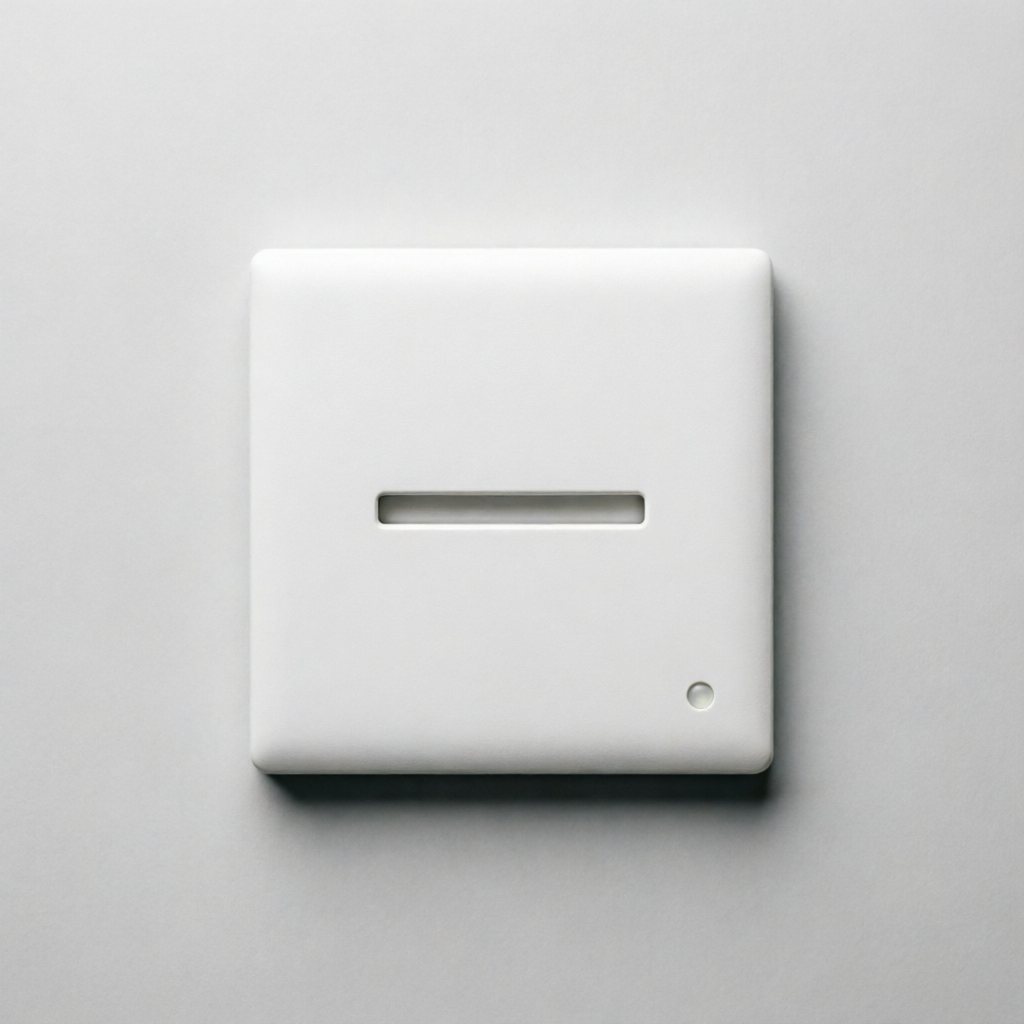
Walk into most mid-market hotel rooms and the first thing you do is slide a card into a slot by the door. That slot is a key card power switch — a mechanical or capacitive holder wired into the room's lighting and socket circuits so that pulling the card out drops non-essential power after a delay, and inserting it restores power immediately. It is one of the simplest and most cost-effective energy devices a hotel can install, but it is also one of the most frequently mis-specified, because buyers often assume "key card switch" is a single standard product rather than a family with real functional differences.
The basic mechanism
- Card present: The switch holds a relay closed, powering the room's lighting circuit, sockets, or both depending on how the room was wired.
- Card removed: A timer (commonly a short delay, configurable per project) begins; at expiry the relay opens and cuts the controlled circuits.
- Card reinserted: Power restores immediately, with no delay, so a returning guest is not left standing in the dark.
The delay on removal exists so the room does not go instantly dark the moment a guest steps out to the corridor ice machine — a design detail worth confirming per project, since expectations differ between budget and upscale properties.
What the card actually reads
Older key card switches are purely mechanical: any card of the right physical dimensions triggers the holder, magnetic stripe or RFID chip irrelevant. Newer versions add an RFID reader that specifically validates the property's guest card format, which prevents a guest from defeating the switch with a spare hotel loyalty card or a cut piece of plastic left in the slot. For properties already running RFID room locks, matching the card-switch reader to the same card format is worth specifying explicitly — it is a separate purchasing decision from the door lock even though it uses the same physical card.
What gets cut, and what does not
This is the detail that causes the most callbacks after installation. A key card switch is normally wired to cut non-essential loads only: general lighting and non-critical sockets. It should never cut the minibar fridge circuit, life-safety lighting, smoke detectors, or the HVAC control electronics (even if the compressor itself cycles down for energy saving, the control board typically stays powered). Buyers need to confirm the room's circuit split with the electrical contractor before finalizing the switch spec — the switch itself does not decide which loads it controls; the wiring behind it does.
| Load type | Typical treatment |
|---|---|
| General room lighting | Cut on card removal |
| Non-critical sockets (desk, bedside) | Cut on card removal |
| Minibar fridge | Always powered |
| Smart switch / scene panel control power | Confirm per project — some panels need standby power to hold state |
| HVAC control board | Always powered; compressor may still cycle down separately |
Integrating with the rest of the room's smart devices
On rooms that already carry a smart scene panel and other connected devices, the key card switch needs to be sequenced correctly with them: if the panel itself loses power the instant the card is pulled, it cannot hold DND/Make Up Room state or report anything to the property's automation layer, which is the exact opposite of what the companion piece on DND and Make Up Room scene panels assumes. The practical fix is to keep the panel's own control circuit on an always-on tap, separate from the lighting/socket loads the card switch controls — a wiring decision the electrical contractor needs flagged before install, not discovered afterward.
Retrofitting an existing property
New-build hotels can plan the circuit split and card-switch wiring alongside the electrical design from day one. Retrofits are a different exercise: the existing wiring may already have lighting and sockets on shared circuits that were never designed with a future key-card cutoff in mind, and separating them can mean opening walls that a refit budget did not plan for. A practical middle path many retrofit projects take is to cut only the general lighting circuit initially, leaving sockets always-on, and revisit socket-level control in a later phase once the wiring budget allows a cleaner split. This is a compromise worth discussing openly with the property owner rather than one the switch supplier should decide unilaterally — the energy-saving benefit is smaller with lighting-only cutoff, but the retrofit cost and disruption are also smaller. Buyers evaluating a retrofit should ask their electrical contractor for an as-built circuit diagram before finalizing which cutoff scope is realistic for the budget, then bring that scope to the RFQ rather than assuming full lighting-and-socket cutoff is always achievable on the first pass.
What to specify in the RFQ
State whether a mechanical or RFID-reading version is needed and, if RFID, the card format already in use for room locks; confirm the delay-on-removal timing expected; and list exactly which circuits the switch should control versus which must stay always-on (especially if a scene panel or bedside control panel is also being installed in the same room). A sample SKU used in these programs is the PL-HT-CARD-UK hotel key card switch; confirm frame type and market variant for your project in the RFQ.
Retrofitting or specifying key card switches at scale?
Share your circuit split and card format with our trading desk — we will confirm compatible switch and panel SKUs so wiring only needs to happen once.
Start RFQ