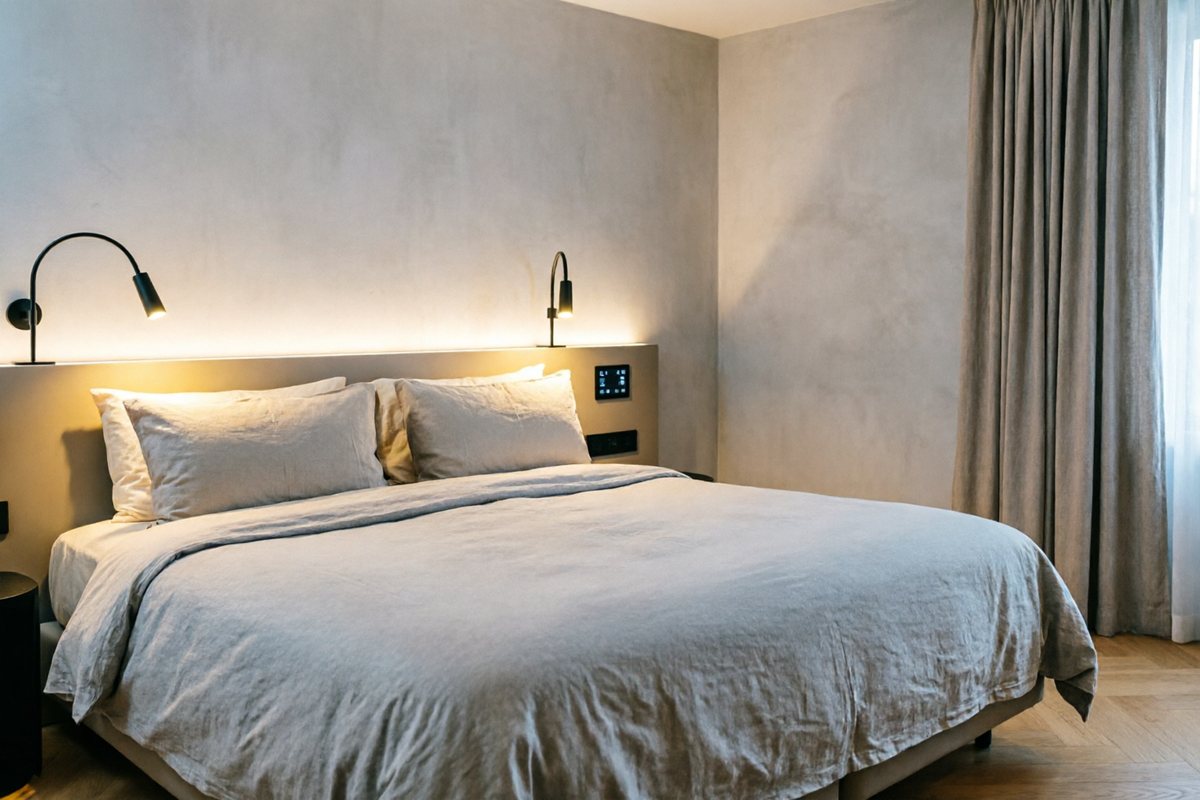
A hotel bedside panel is not one product category — it is a bundle of decisions about which functions live within arm's reach of a half-asleep guest at 2 a.m. Reading light, main room light, DND/Make Up Room, curtain, sometimes climate and a USB charging point all compete for the same small footprint. Buyers who treat this as "just order the bedside switch" tend to discover mid-project that the panel they picked cannot fit every function the interior designer promised the client. This guide sets out what to decide before the RFQ goes out, not after.
The core function list
- Reading light zone control: Independent left/right bed-side lamp control, since one guest sleeping and one reading is a common real-world case.
- Main room light and scene recall: A "welcome" or "sleep" scene button that sets multiple lights and curtains at once, distinct from single-zone toggles.
- DND / Make Up Room: Covered in depth in the companion piece on DND and Make Up Room scene panels — decide early whether this lives on the bedside unit, the entry panel, or both.
- Curtain/blind control: Often placed on the bedside panel for convenience even when the motor itself is elsewhere in the room.
- USB/USB-C charging: Increasingly expected by guests; adds a load and a socket certification requirement to the panel spec.
- Alarm or wake call integration: On higher-end properties, sometimes tied into the PMS wake-call function rather than a standalone clock.
Not every room class needs every function — a budget property may keep the bedside panel to lighting and DND only, while an upscale property bundles all six. Deciding the function list per room tier before quoting avoids a mid-project redesign.
Panel form factor and mounting
Bedside panels are usually a wider format than a standard wall switch — enough surface for 4-8 buttons or a small touch display — and they mount either on the wall directly above the nightstand or, in some builds, embedded into a headboard unit supplied by the furniture contractor. The mounting choice affects wiring: a headboard-embedded panel needs its cable run coordinated with the furniture delivery schedule, which is a project-management detail worth raising with the general contractor early, not something the switch supplier controls.
Protocol and integration fit
The bedside panel almost always needs to talk to the same gateway or hub as the room's other devices — curtain motor, main lighting circuit, and the entry-door DND indicator if that logic is shared. Mixing protocols across the room (say, a Wi‑Fi bedside panel next to a Zigbee curtain module with no shared gateway) creates two apps for one room and doubles the support burden for hotel IT staff. Confirm the protocol used across the room's device set before finalizing the bedside panel SKU; see the Protocols page for the general Wi‑Fi/Zigbee/Matter trade-offs that apply here.
| Room tier | Typical bedside function set |
|---|---|
| Budget / midscale | Reading light + main light + DND |
| Upscale | Above + scene recall + curtain + USB-C |
| Luxury / suite | Above + climate shortcut + PMS wake-call link |
Certification and electrical notes
Any panel offering USB/USB-C charging adds a power-delivery component that needs its own safety certification alongside the switch mechanism's mark — treat it as a separate line in the certification checklist rather than assuming the switch certificate covers it. See the general certification landscape on the Certifications page, and flag the target export market early since USB output certification requirements are not identical across regions.
Usability for a half-asleep guest
Bedside panels are used in low-light conditions by guests who are often reaching for the control without looking directly at it — this is a different usability context from a hallway light switch a guest deliberately walks up to and views in daylight. Button spacing, tactile differentiation between functions (so a reading-light button does not feel identical to the DND button by touch alone), and backlighting that is visible but not bright enough to disturb sleep all matter more here than on any other panel in the room. Icon-only labeling, as discussed for entry-door DND indicators, works well for international guests but should be paired with enough tactile or positional distinction that a guest is not forced to turn on a bright light just to identify which button does what. Buyers should ask to see or trial a physical sample of the bedside panel in a dark room before committing to a large order, since this kind of usability issue is difficult to judge from a spec sheet or product photo alone.
What to put in the RFQ
List the exact function set per room tier, confirm mounting method (wall vs. headboard-embedded) and whether furniture coordination is needed, state the protocol shared with the rest of the room, and flag whether USB-C output is required and at what wattage. Reference the room's key card switch wiring too — as covered in the companion piece on key card power switches, the bedside panel's own control power should typically sit on an always-on tap separate from the card-switched lighting circuit.
Specifying bedside panels for a hotel refit?
Send us your function list by room tier — our trading desk will confirm compatible panel SKUs, mounting options and lead times based on your spec.
Start RFQ