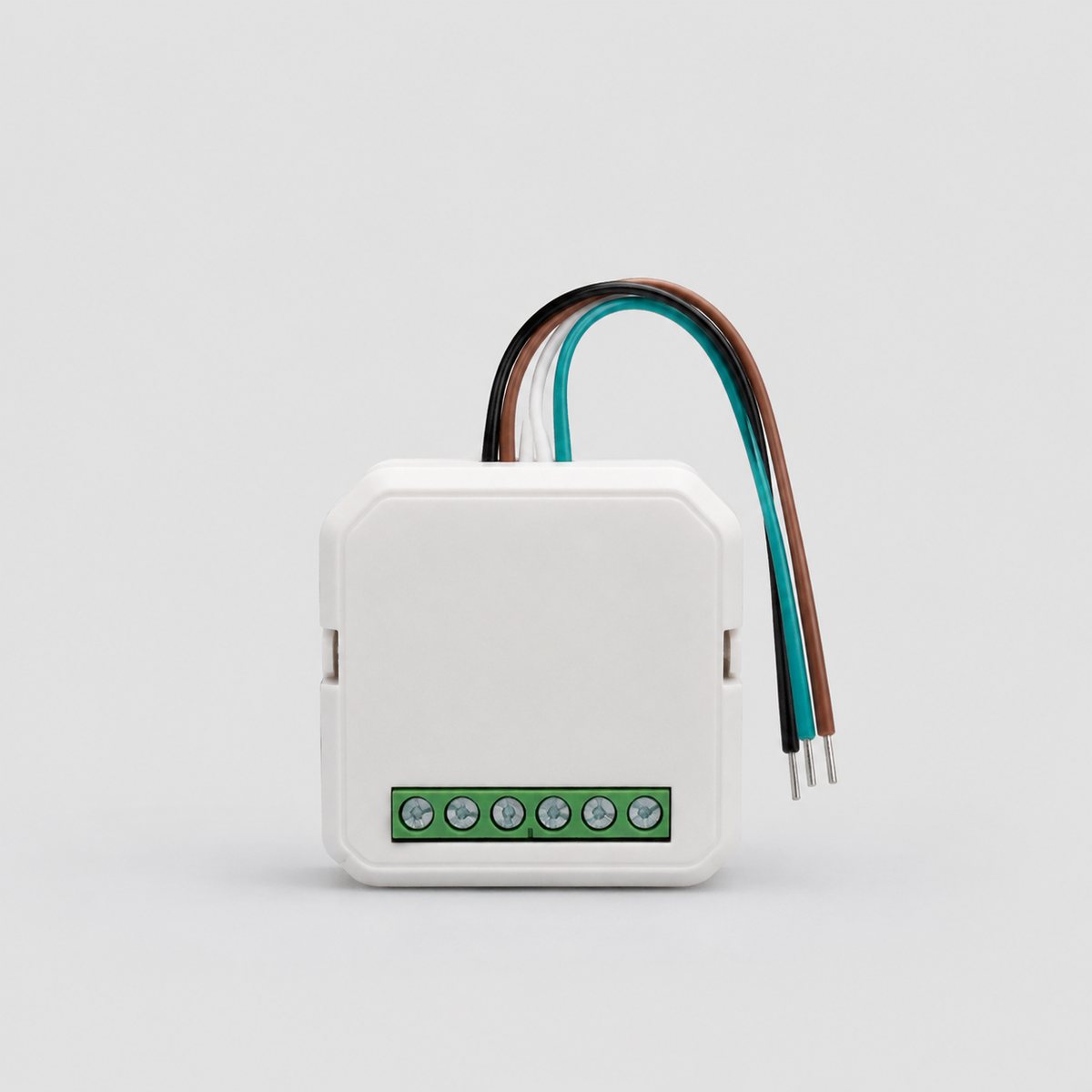
Of all the device categories in a smart-switch program, curtain and blind control is the one most likely to fail at installation because of a mismatch nobody caught at RFQ stage. Unlike a light switch, which almost always controls a simple on/off or dimmable load, a curtain module has to match a specific motor's control interface, direction logic and travel-limit behavior. Buyers who order curtain modules the same way they order wall switches — by protocol and app brand alone — frequently find the module arrives compatible with the wrong motor family.
Motor types the module has to match
- AC motor tubular, dry contact / 3-wire control: The most common in curtain track systems; the module needs relay outputs matching the motor's open/close/stop wiring.
- RF-receiver-integrated motors: Some curtain motors already include their own RF receiver from the motor manufacturer; in this case the "smart" module is really a bridge that mimics the original RF remote rather than a direct relay connection.
- Bus-based / proprietary curtain systems: Higher-end architectural curtain systems sometimes use a proprietary control bus, which a generic smart module cannot join without a compatible interface from the same curtain-system vendor.
The practical implication: "curtain module" is not a single SKU decision. The buyer or the site's electrical contractor needs to identify which of these three families the installed (or specified) motor belongs to before the trading desk can confirm a compatible module.
Wiring rules that get missed
Curtain motors need a clear open/stop/close signal path and, in dry-contact designs, physical travel-limit switches set during motor installation — the smart module does not know where the curtain physically ends unless the motor's own limit switches are set correctly first. A module wired to a motor with unset or incorrectly set limits will either stop early, leaving a gap, or keep driving after the curtain is fully open/closed, straining the motor and track over time. This is a mechanical commissioning step that has to happen before or during electrical connection, not something the smart control layer can compensate for after the fact.
| Item | Who confirms it | When |
|---|---|---|
| Motor control interface (dry contact / RF / bus) | Curtain motor manufacturer or site contractor | Before ordering the smart module |
| Travel limit switches set correctly | Installer, during motor mounting | Before or during electrical wiring |
| Module protocol matches room gateway | Buyer / trading desk | At RFQ stage |
| Load rating (motor current draw) | Trading desk against motor spec sheet | At RFQ stage |
Protocol compatibility with the rest of the room
Once the mechanical/wiring match is confirmed, the module's radio protocol should follow the same rule as every other device in the room: match the gateway already in use, whether Wi‑Fi or Zigbee, so the curtain sits in the same app and automation rules as the lights and scene panel rather than requiring a second app just for window coverings. See the Protocols page for the general Wi‑Fi/Zigbee trade-offs, and the companion piece on bedside control panels for hotel rooms for how curtain buttons are typically integrated into the same bedside control surface in hospitality projects.
Power and load considerations
Curtain motors draw meaningfully more current at startup than a lighting load of similar continuous rating, particularly for heavier drapery or larger blind spans, so the relay or module driving the motor needs a current rating that accounts for that startup surge, not just the motor's steady running current. Buyers specifying curtain modules for larger commercial spans (floor-to-ceiling drapery in a hotel lobby, for example, versus a standard bedroom window) should share the motor's full spec sheet — including startup current, not only running wattage — with the trading desk so the module recommendation is not undersized. It is also worth confirming the module's own power source: some curtain modules tap directly into the same mains circuit as the motor, while others (particularly retrofit RF-bridge types) run on their own low-voltage supply or battery, which changes the installation and maintenance profile.
What to write in the RFQ
State the curtain motor brand and model if known, or at minimum the control interface family (dry contact / RF-integrated / bus); confirm whether travel limits are already set on installed motors or will be set during this project; and state the protocol/gateway already used for the room or property. A sample module used in these programs is the PL-CT-MOD-WIFI curtain control module; confirm the specific motor compatibility for your project before ordering, since — as above — this is a per-motor-family decision rather than a universal fit.
Adding curtain control to an existing switch program?
Share your curtain motor details and current protocol with our trading desk — we will confirm module compatibility before you commit to a quantity.
Start RFQMotor Types and What They Change in Your Order
Curtain control is specified around the motor as much as the switch. AC tubular motors are the workhorse for larger windows and are usually controlled through a wall module that switches or signals them; DC motors dominate smaller blinds and carry low-voltage wiring that must be planned into the wall box. The two do not interchange, and a quote that ignores which motor sits behind the curtain will come back with the wrong module. Ask your curtain supplier — or state in the RFQ — motor voltage, torque class and control interface, the same way you would state a switch's protocol.
Compatibility questions multiply in mixed buildings, where a developer's standard curtain motor meets an imported switch line. The safe pattern is a sample pairing: your switch module driving your actual motor, exercised through full open-close cycles before mass production. It costs one sample round and prevents the classic site discovery that the module's relay chatters with that motor's inrush or that the travel limits reset on every power cut. Packaging the pairing test into the sample approval is a one-line addition to your RFQ that removes an entire category of site callbacks.
For distributors carrying curtain control alongside switches, the merchandising detail matters: sell the pairing as a package. Customers who buy the motor and the wall module together have one integration story, one support contact and one sample approval — which is precisely why the desk consolidating both lines can price the bundle better than two separate purchases. State package availability in the RFQ and let the consolidation do its work on this line too.