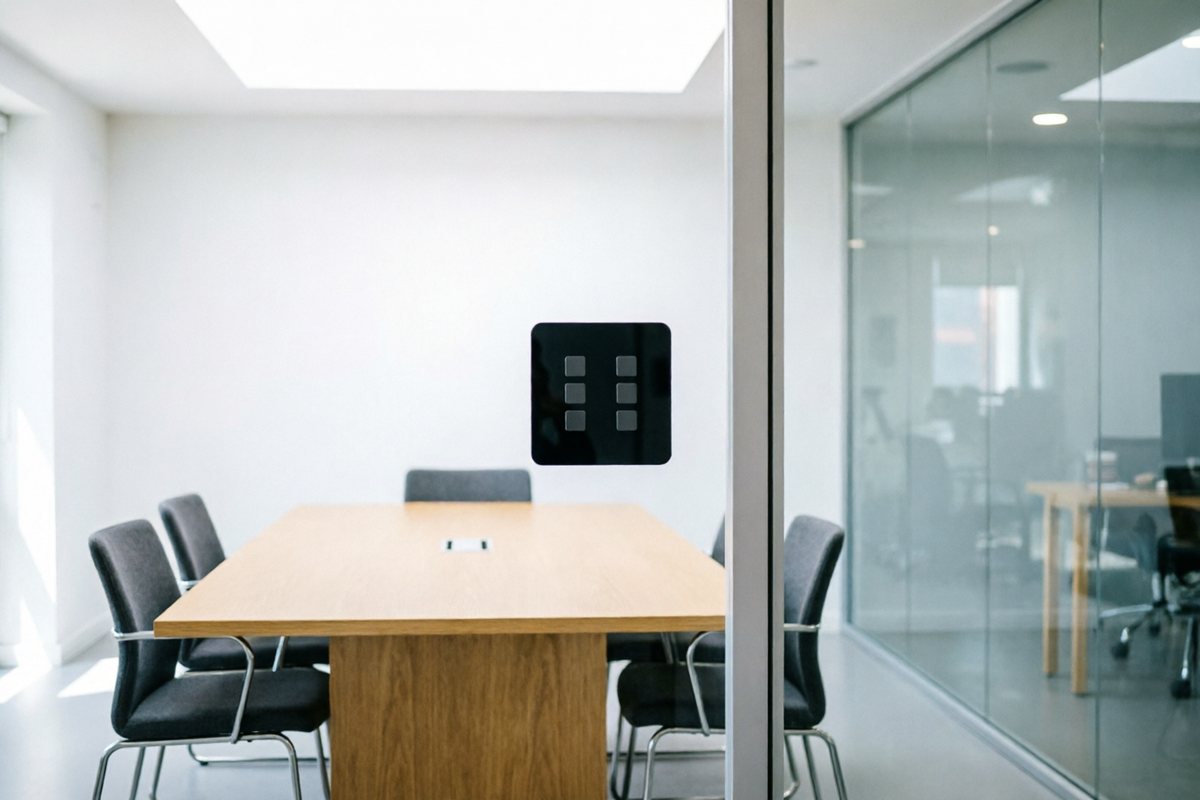
Co-working operators run a fundamentally different lighting problem from a normal office: the floor plan is divided into zones (open desks, phone booths, meeting rooms, common areas) that turn over between tenants and bookings all day, not once at 9am and once at 6pm. This brief is written for operators and facilities buyers writing an RFQ for lighting control across one or several sites, not for a single-tenant office fit-out.
Zone control is the actual requirement, not "smart lighting" in general
Most co-working requests reduce to: let each zone follow its own schedule and be overridden independently, without one switch affecting an unrelated area. Meeting rooms need on-demand control tied to bookings; open desk areas need a simple daytime schedule; common areas need a slightly different evening scene for events. Spec the panel layout by zone count first, then choose gang configuration and finish — starting from the finish and working backward tends to under-provision zones.
Meeting rooms: booking-linked control, not manual toggling
A meeting room that is dark when a booked meeting starts, or stays lit for hours after a meeting ends, is one of the most common complaints in shared workspace operations. Where the operator already runs a booking system, ask the supplier whether the proposed switch or scene panel supports schedule/API-triggered control, versus purely manual or app-toggled operation. If integration is not confirmed as supported, plan for a simple occupancy-sensor fallback instead of assuming a booking-system link will work out of the box — see the product catalogue for available occupancy sensor SKUs.
Occupancy sensing for phone booths and small rooms
Phone booths and small meeting rooms are a good fit for PIR occupancy sensors paired with the lighting circuit, since usage is short and unscheduled — nobody books a phone booth in a calendar. This reduces the "light left on" complaint that otherwise generates facilities tickets across a busy floor.
Multi-site consistency
Operators running several locations should push for one scene-naming and account-role convention across every site, the same principle covered in our retail lighting control brief. A facilities manager checking on a new site should recognize the same zone structure they already know from an existing one, rather than relearning a bespoke setup per building.
| Zone type | Control approach |
|---|---|
| Open desk area | Daily schedule, manual override at wall |
| Meeting room | Booking-linked if supported, else occupancy sensor fallback |
| Phone booth / small room | PIR occupancy sensor |
| Common / event area | Scene panel with a small number of preset scenes |
Retrofit reality in leased floors
Co-working fit-outs are almost always inside a leased shell, on a fit-out timeline that does not include rewiring. Confirm neutral wire availability at each switch location before finalizing the BOM — our neutral vs no-neutral guide covers what changes in the module choice when it is missing, which is common in older commercial buildings being converted to co-working use.
Protocol and scale
A single floor with a handful of zones rarely needs a dedicated gateway; Wi‑Fi covers it. Once an operator is running several floors or buildings with dozens of sensor-linked zones, a mesh protocol such as Zigbee reduces the load on each site's Wi‑Fi network — see our protocol comparison for the trade-offs at that scale, and confirm gateway scope explicitly in the RFQ rather than assuming it is bundled.
Fitting out a co-working floor or multi-site portfolio?
Send zone count per site and booking-system details — our trading desk will confirm which control approach fits each zone type.
Start RFQSpecifying Scenes That Survive Different Tenants
Co-working spaces re-tenant constantly, and the switch package must survive tenants who never read instructions. Scene panels installed for one tenant's preferences become confusing clutter for the next. The proven pattern is simple base behavior — switches that work like switches the moment power arrives — with scenes layered as an optional layer the operator can rename, re-map or reset between tenancies. Ask how your supplier's scene configuration is backed up and restored; a panel that can be reset to a known state in minutes is worth more in this segment than one with deeper features and no reset story.
Durability weighting also shifts in co-working compared with residential: touch surfaces see hundreds of presses a day, signage films get peeled, and wall plates get moved when layouts change. Order spare plates and replacement glass as a line item rather than an afterthought — a small spares percentage keeps a two-hundred-desk floor presentable between fit-out cycles. State the re-tenanting expectation in your RFQ so the supplier proposes panels with a managed configuration story rather than the lowest-touch residential part.
Lastly, involve the community team in the sample review. They see how members actually use the space — which corners get chosen for calls, when the evening rush happens, where the light is wrong at four in the afternoon in winter. One walk-through with the operations team converts a generic specification into an informed one, and the scenes they help design are the scenes that survive re-tenanting, because the next tenant inherits behavior that made sense rather than behavior that was merely installed.
The operator economics close the brief: lighting control in co-working is paid for by the meetings it enables and the energy it saves, and both are measurable. Spaces that track scene usage and after-hours consumption can show operators the numbers within a quarter, and the numbers renew the fit-out budget for the next floor. Specify the panels, then propose the measurement — a supplier who can report usage through the management layer turns every installation into the case study that sells the next one, which is how a single brief becomes a chain-wide standard.