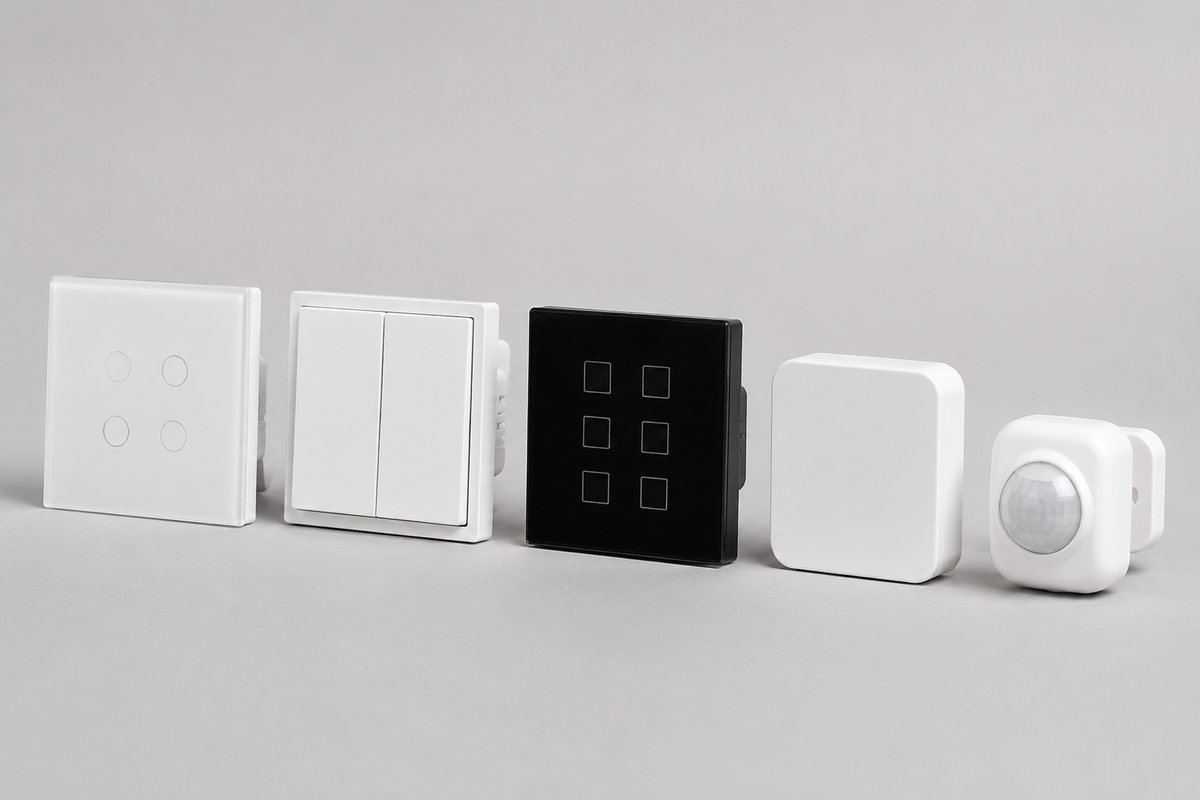
Buyers launching a private-label smart home line tend to arrive with a long wish list already formed — own app, custom mould, full color family, multi-market certification — before a single unit has sold. Most of that list is worth building toward, but almost none of it belongs in the first order. This is a sequencing guide: what to lock early because it is expensive to change later, and what to deliberately defer until real sales data justifies the investment.
Lock these decisions before the first RFQ
- Protocol/ecosystem: Wi‑Fi or Zigbee, and which app ecosystem the module will pair to — this affects every SKU decision downstream and is expensive to reverse once inventory exists. See Protocols.
- Target markets and their certs: deciding markets after production, rather than before, is the most common cause of unsellable stock. See Certifications.
- Frame standard: 86-type, EU, US or UK box standards are not interchangeable, and this must match the destination market's electrical convention.
Start branding at the OEM level, not the ODM level
The fastest path to a sellable branded product is logo print and packaging customization on an existing, already-certified SKU — see logo printing & packaging customization. This keeps MOQ close to standard and lead time short. A new mould, a proprietary enclosure, or a fully private app are ODM/NRE-level investments that make far more sense once a pilot has proven demand — jumping straight to them on an unproven concept is the single most common way private-label budgets get burned early.
Defer these until volume justifies them
| Item | Why it can wait | What signals it's time |
|---|---|---|
| Private-label app (Level 2/3) | High NRE, long build | Proven reorder volume, need for app-level differentiation |
| New mould / ODM enclosure | Tooling cost, longer validation | Category leadership ambition, defensible design need |
| Full multi-market cert set | Cert cost scales per market | Confirmed demand in each specific market |
| Metal/premium finish variant | New frame material, new SKU | Premium tier demand proven at standard finish |
Run a pilot before scaling brand investment
A pilot order — one SKU family, one market, OEM-level branding — answers the questions that matter before real money goes into app development or tooling: does this product sell at this price point, what is the actual return/support load, and which market responds best. See custom app branding options for how app investment should map to the volume this pilot generates, rather than being decided upfront on ambition alone.
Documentation to request from day one
Even at pilot scale, request the same documentation set a mature private-label programme would need later — datasheets, cert copies, QC reports — so the paper trail exists before it becomes urgent for a bigger order or a retailer audit. The full list is in OEM documentation checklist.
What to state in the RFQ
State your target market(s), preferred protocol, and that this is a pilot/private-label build so the factory quotes OEM-level branding rather than assuming ODM. Browse the product catalogue for SKU families with a track record before selecting a pilot product.
Planning your first private-label order?
Tell us your target market and protocol — our trading desk will lay out a realistic pilot-to-scale sequence, not a wish-list quote.
Start RFQThe First Ninety Days: A Realistic Sequence
A private-label launch becomes manageable when it is sequenced. Weeks one to three: lock the category focus — one frame standard, one protocol family, three to five SKUs. Spread wide at the start and every later decision multiplies. Weeks three to six: sample round on existing platforms with your branding applied, checking print quality, app onboarding and packaging against your market's expectations. Weeks six to ten: certification review for your destination market and a small first production run sized to sell through, not to fill a warehouse.
The most common sequencing mistake is inverting samples and branding: buyers spend the first month designing a logo and the second discovering their chosen SKU cannot support the print or the app name they planned. Reverse that order — confirm the hardware and its customization limits first, then wrap the brand around what the hardware accepts. A trading desk that consolidates switches, panels and gateways under one RFQ shortens this sequence, because the compatibility questions get answered by one desk instead of three factories.
One discipline holds the sequence together: write decisions down as they are made. The chosen frame, the confirmed protocol family, the app tier, the certification list, the packaging language — each becomes a line in your brand specification, and the specification becomes the brief every future supplier, designer and distributor works from. Brands stall when decisions live in inboxes; brands compound when decisions live in a document. The spec does not need to be elegant — it needs to be current, and the habit of keeping it current is itself a founder-level discipline worth building from day one.
Brand reviews deserve a calendar slot too. Twice a year, read your own listing pages, packaging and app screenshots as a stranger would, and note every inconsistency that accumulated one small decision at a time — a finish renamed, a tone shifted, a logo version drifting. The half-day audit keeps the brand coherent while it is still cheap to align, and it doubles as the input for the next supplier brief. Brands that audit twice a year rarely need rebrands; the small corrections, applied early, are what the big consistency is made of.