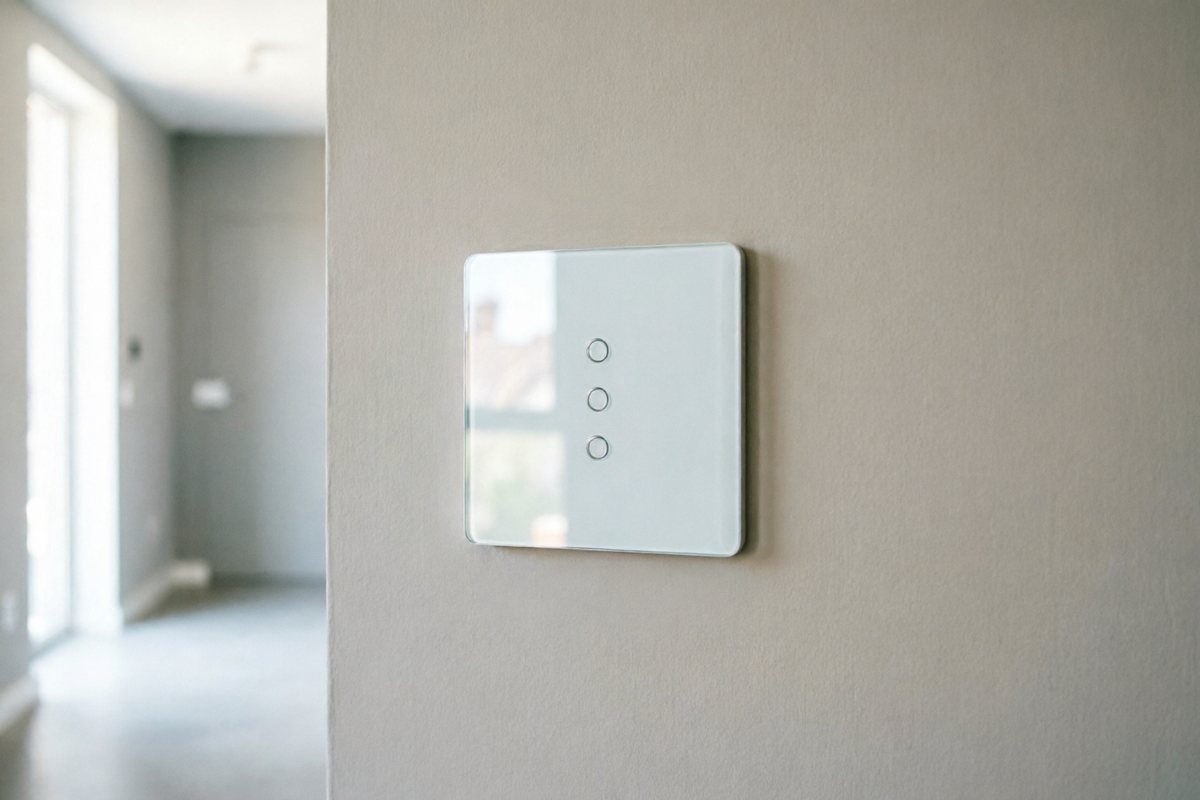
Distributors building a catalogue almost always start with the same question: lead with a capacitive touch panel, or a mechanical rocker with smart internals bolted on? Both are shipped in volume, both pass the same certification lanes, and both control the same relay behind the wall. The difference that actually matters for a B2B buyer is not "which looks nicer in a showroom photo" — it is buyer perception by market, failure mode over years of use, and how each fits into an existing RFQ or renovation spec. This guide is written for importers and installers who need to decide a stocking ratio, not for end users picking a finish.
Touch switches: flush glass, no moving parts
A capacitive touch switch reads a finger's capacitance change through a glass or acrylic face; there is no physical rocker to press. That gives it a flat, wipeable surface and a light-up icon set that many markets now associate with "smart" out of the box.
- Pros: Flush glass face reads as premium in listing photos; no mechanical wear part to fail; consistent light-touch actuation regardless of installer torque; easier to silk-screen custom icon sets for OEM.
- Cons: Needs a stable capacitive threshold — wet fingers or condensation can cause false or missed touches; glass face shows fingerprints and requires wipe-clean messaging in listings; slightly higher unit cost than an equivalent rocker.
- Sample SKU: PL-SW-T3-WIFI-86 (3-gang Wi‑Fi touch, 86-type)
Rocker switches: mechanical click, price-sensitive fit
A smart rocker keeps the familiar mechanical paddle that most markets already know from non-smart switches, with the smart module wired behind it. The feel is closer to what an installer or landlord has replaced for decades.
- Pros: Tactile click gives clear physical confirmation without relying on an app or a light strip; generally lower landed cost per gang; easier retrofit narrative for buyers replacing existing mechanical switches one-for-one; less sensitive to humidity than capacitive faces.
- Cons: Moving parts wear over repeated cycles; paddle finish (usually PC plastic) reads as less premium than glass in marketing photos; fewer OEM options for illuminated icon customisation.
- Sample SKU: PL-SW-R2-ZB-EU (2-gang Zigbee rocker, EU frame)
Buyer perception by market
| Buyer segment | Lean touch | Lean rocker |
|---|---|---|
| New-build apartments, showroom-driven sales | Yes — glass face photographs well | Secondary line |
| Landlord / rental retrofit, cost-driven | Optional upsell | Yes — familiar feel, lower cost |
| Hotel corridors and back-of-house | Depends on cleaning protocol | Often preferred for robustness |
| Humid or coastal climates | Confirm capacitive tolerance in RFQ | More forgiving by design |
Failure modes worth asking about before you quote
Neither style is inherently more reliable — they fail differently. Touch panels are more exposed to environmental false-triggers (condensation, cleaning liquid pooling on the face) than to mechanical fatigue. Rocker switches are the reverse: the mechanical actuator is the wear item over a long service life, while the electronics behind it are largely shared with the touch line. If a buyer's end market has a harsh cleaning regime (hospitality, healthcare-adjacent), ask the factory about the specific capacitive sensitivity spec and any IP rating on the touch line — see our companion piece on how capacitive touch panels actually work for the sensor-level detail. If the market is landlord-driven renovation with tight per-unit budgets, a rocker line usually clears the RFQ faster on price alone.
Cost delta and margin implications
The landed-cost gap between a touch and a rocker line is usually modest per unit, but it compounds across a large order and interacts with how each line is marketed. Touch panels tend to carry a higher retail multiple relative to their cost delta, because the glass face and light-up icon set support a "premium" positioning that resale buyers can charge more for — which is why many catalogues use touch as the margin-favourable hero line even though the landed cost difference from rocker is not dramatic. Rocker lines compete more directly on price and volume, which suits distributors serving landlord and renovation channels where the buyer is comparing switch cost against a tight per-unit renovation budget. Neither approach is wrong, but the two lines are usually sold with different pricing logic, and a distributor's sales team should know which story to tell for which SKU rather than pricing both the same way by default.
Sample testing before committing to volume
Because face-style preference is partly aesthetic and partly about physical feel, it is worth requesting small sample runs of both a touch and a rocker SKU before locking a full production order — especially for a new distributor entering an unfamiliar market. A short in-market test (showroom display, a handful of installer opinions, or a small pilot batch to early customers) can surface local preference faster than assuming a pattern from another market transfers directly. This is a low-cost step relative to the risk of over-committing to one face style only to find the target market actually prefers the other, and it pairs naturally with the stocking-ratio conversation below.
Stocking strategy for distributors
Most catalogues that convert well carry both lines rather than betting on one face style. A common structure is a touch line as the "hero" SKU for marketing and showroom listings, backed by a rocker line at a lower price point for cost-sensitive resale. Both can usually share the same Wi‑Fi or Zigbee back-end module family, which keeps the certification and app-pairing story consistent across the catalogue — worth confirming per factory rather than assuming. For a broader view of how face style interacts with wiring and protocol choices, see the product catalogue and the general buyer's guide to choosing a smart wall switch.
Whichever mix you land on, state the ratio explicitly in your RFQ — for example "70% touch 3-gang, 30% rocker 2-gang, same frame colour family" — so the trading desk can consolidate factories into one shipment plan instead of quoting each line separately.
Deciding your touch-to-rocker stocking ratio?
Send your target market and price ceiling in one RFQ and our trading desk will confirm face-style mix, protocol and frame options across partner factories.
Start RFQ