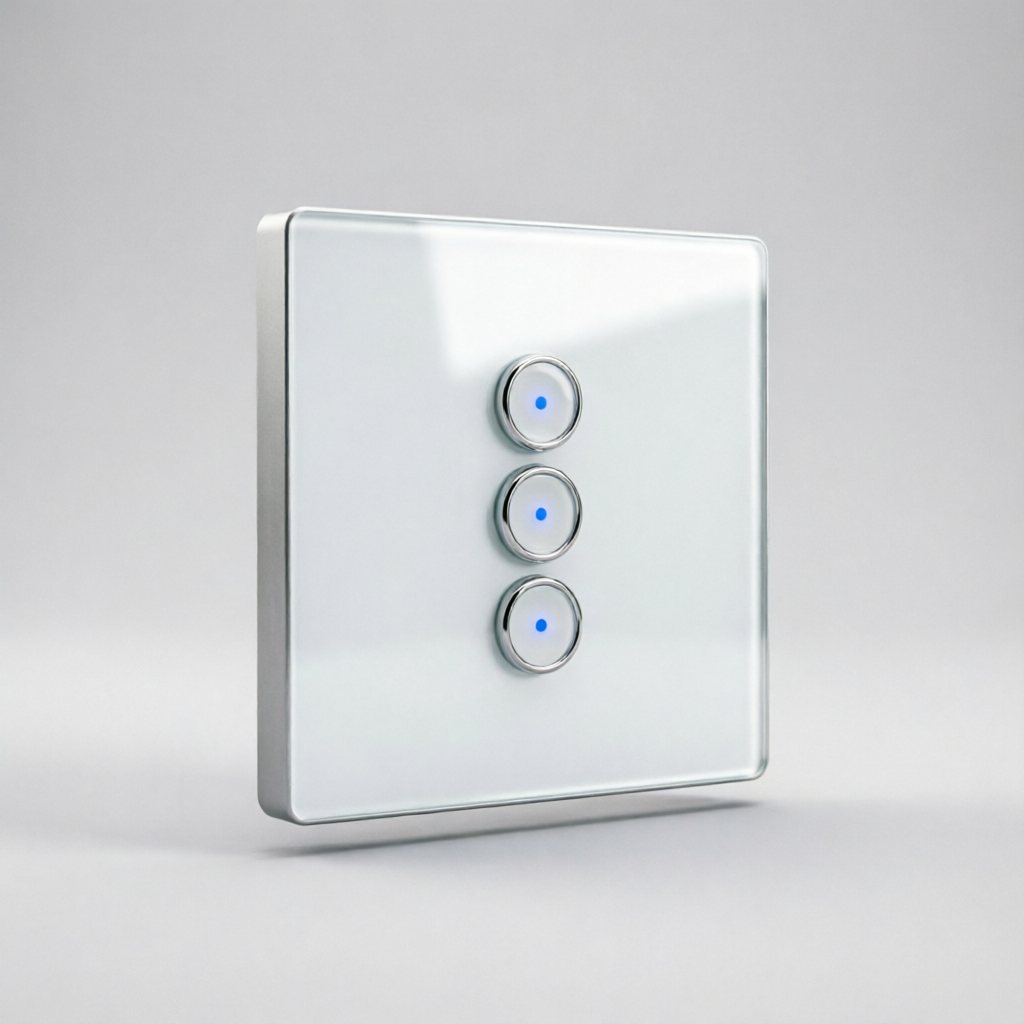
Almost every switch listing on a trading platform says "works with Alexa and Google Home." For a B2B buyer writing an RFQ, that phrase needs unpacking, because it describes a cloud account link, not a fixed hardware feature that transfers automatically across every SKU, region and firmware version. This article explains what actually connects a wall switch to a voice assistant, where the paths diverge by protocol, and what to put in writing before a claim like this ends up in your own product listing.
What "compatible" actually means
Voice compatibility runs through an account-level cloud link, not a direct radio connection between the switch and Alexa or Google Home. A Tuya-class Wi‑Fi switch links its app account to the voice assistant's skill or action, which is a software integration layered on top of the switch's existing Wi‑Fi connection. This means voice compatibility can, in principle, be added or removed via firmware and app updates without changing the switch's radio hardware — but it also means it can silently break if the skill integration is deprecated or the app account structure changes, which is worth asking about for long-term product lines.
Wi‑Fi path vs Zigbee-plus-gateway path
| Path | How voice access works | What to confirm |
|---|---|---|
| Wi‑Fi (Tuya-class) | Switch app account links directly to Alexa/Google skill | Which app stack; skill enabled per target region |
| Zigbee + gateway | Gateway bridges to cloud; voice assistant talks to the gateway account, not the switch directly | Gateway brand's own skill/action support, not just the switch |
| Matter (bridge or native) | Multi-admin — one certified device can, in principle, be controlled by multiple ecosystems | Certification status per SKU; native vs bridged behavior |
The practical implication: for Zigbee installs, voice compatibility is really a claim about the gateway's cloud integration, not the switch in isolation. A buyer quoting a Zigbee switch without specifying the paired gateway is quoting an incomplete voice-compatibility claim.
Where Matter changes the picture
Matter is relevant here because its coalition — Apple, Google, Amazon and Samsung — covers more than 95% of the voice-assistant market, and the standard is designed for multi-admin control (multiple ecosystems controlling the same certified device). With more than 4,000 certified devices and version 1.6 released in June 2026, Matter is genuinely narrowing the gap between "works with Alexa" and "works with Google Home" as two separate claims. But this only applies to SKUs with confirmed Matter certification — see our companion piece on how Matter is reshaping manufacturing for what that certification actually requires from a factory.
Language pack and region considerations
Voice skill enablement is not automatically global. A skill or action can be live in one language market and pending in another, independent of the switch's hardware readiness. Buyers targeting a specific voice-assistant market should ask the factory or brand owner to confirm skill enablement for that market's language pack specifically, rather than assuming "works with Alexa" travels automatically to every territory.
RFQ checklist for voice compatibility claims
- Which app stack handles the cloud link (Tuya/Smart Life, private label, gateway brand)
- Whether the claim applies to the switch directly or via a paired gateway
- Confirmed skill/action enablement for your target market's language
- Matter certification status, if the claim relies on Matter multi-admin rather than a direct skill
See our Protocols page for the fuller RFQ checklist covering voice alongside radio and gateway choices.
Need a written voice-compatibility confirmation?
State your target voice ecosystem and market in the RFQ; our trading desk will confirm the app stack and skill enablement before you quote it downstream.
Start RFQVoice Ecosystem Questions for Your RFQ
Voice compatibility is claimed broadly and works specifically. The questions that sharpen a quote: which voice platforms does this SKU integrate with today — natively, through the app's cloud skill, or through a Matter path — and is that list identical across the frame and protocol variants I am buying. What is the onboarding path per platform, and how many steps does a non-technical customer complete. Is localization of voice interactions included for my market's language, or is voice effectively English-only. And what changed in the last app release that touches voice flows, since these flows move with updates.
The answers sort products more honestly than the compatibility logos on the box. A switch that reaches a voice platform through a cloud skill works until the internet does not; a Matter-native path behaves differently offline and costs differently to certify. Neither is wrong, but your customers will experience the difference and call you about it. Record the answers per SKU in your order file — voice behavior is a top retail-return driver when it disappoints, and the file is what lets you answer the channel confidently. A consolidating desk tracks these flows across the lines it ships and can usually tell you which protocol family pairs best with the ecosystem your market actually uses.
For the range plan, the ecosystem question deserves one column in your SKU table: primary ecosystem alignment per product, based on your markets actual device mix rather than global headlines. Some territories lean heavily one platform; others split by demographic. Aligning your hero SKUs with the dominant local ecosystem — and saying so in your listing — converts a compatibility footnote into a merchandising advantage. The data is in your own reviews and returns; the column costs one spreadsheet tab and prices the ecosystem question exactly where it is decided.