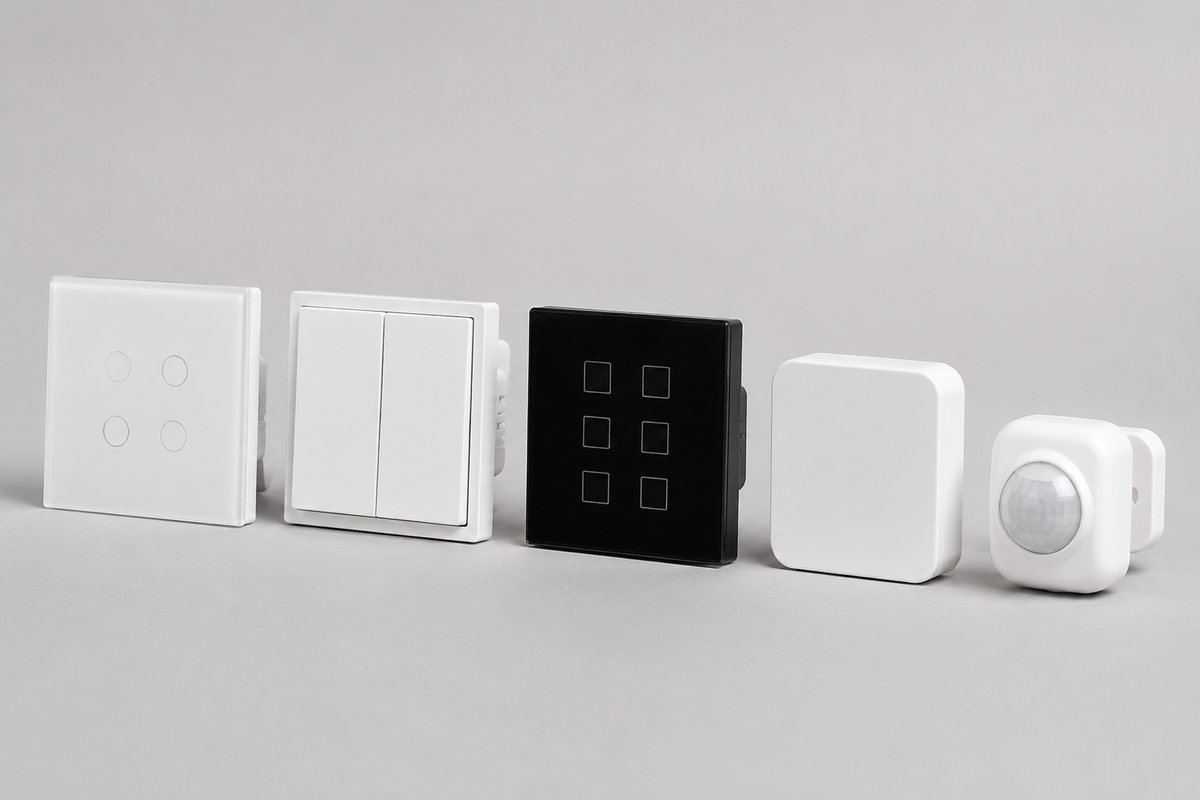
Every sourcing conversation this year eventually references the same market-size chart. It is a useful chart, but on its own it does not tell a distributor which SKUs to stock, which protocol to commit to, or how much inventory risk to carry into next year. This article works through the number and what it implies for a trading desk that has to make catalogue decisions, not just cite growth statistics.
The numbers behind the headline
The smart home market is estimated at roughly USD 180.12 billion in 2026, with forecasts putting it at approximately USD 848.47 billion by 2034. Taken at face value, that is close to a 4.7x expansion over eight years — which, worked through as a compound rate, implies growth in the neighborhood of 20% a year if the trajectory holds evenly (it will not hold evenly; markets do not grow in straight lines). The useful takeaway for a distributor is not the precise percentage. It is that the category is still in an expansion phase rather than a mature, slow-growth one, which changes how much shelf space and RFQ attention it deserves relative to other product lines in the catalogue.
Where the growth actually lands
Aggregate market-size figures blend several very different buyer types, and they are not growing for the same reasons. New-build residential and commercial construction is specifying wall control at the design stage rather than leaving it as an aftermarket upgrade — a shift covered in more depth in our note on property developers specifying smart switches at scale. Hospitality renovation cycles are a second driver, where whole-floor retrofits bundle switches, scene panels and occupancy sensors into a single procurement event, discussed further in our hospitality market snapshot. Retail and short-let residential remain the third leg, generally smaller ticket size but higher unit volume. A distributor building a catalogue for 2027 should weight inventory toward the segment their actual buyer base sells into, rather than assuming the whole market grows evenly across channels.
What changes for a catalogue built on protocol choice
Growth of this size does not arrive on a single radio standard. Matter has passed 4,000 certified devices with version 1.6 released in June 2026, and it is backed by Apple, Google, Amazon and Samsung — a coalition that covers more than 95% of the voice-assistant market. Zigbee remains ahead on raw certified product count, with more than 3,500 certified products already in market, and Zigbee 4.0 — including sub-GHz and SUZI additions — is expected in the second half of 2026. Neither standard is disappearing; both are maturing on parallel tracks. The practical implication for a distributor is to keep both lines live in the catalogue rather than betting the growth forecast on one ecosystem winning outright. See our Protocols page for how we frame that decision for RFQs.
The inventory risk hiding inside a growth chart
Fast-growing categories tempt distributors into over-ordering a single hero SKU on the assumption that demand will simply keep rising. That works until a buyer's spec changes — a hotel group standardizes on a different gateway, or a developer's electrical consultant switches from Wi‑Fi to Zigbee mid-project. The safer posture in a market moving this quickly is breadth across protocol and form factor (switches, scene panels, sensors, gateways) with conservative reorder quantities per SKU, confirmed against actual buyer specification rather than the macro forecast. This is also where working with a trading desk that carries multiple factory relationships — rather than a single-factory reseller — reduces the risk of being stuck with the wrong protocol mix when a segment shifts.
What to put in the RFQ
None of the above changes the mechanics of a good RFQ. Buyers should still state protocol preference, gateway tolerance, device density per room, voice ecosystem requirement, and target certification markets. What the growth data changes is urgency: if a segment is expanding, it is worth locking in supply relationships and sample approvals now rather than waiting for a shortage cycle. Our OEM/ODM page covers how private-label buyers can move from sample to production without losing time to protocol indecision.
Reading a forecast without over-trusting the point estimate
A single headline figure — USD 180.12 billion this year, USD 848.47 billion by 2034 — is easier to repeat in a deck than a range, but it should be read as a trajectory, not a precise prediction. Market-size forecasts of this kind get revised as new data comes in, and different research houses use different scoping (some count only consumer smart home devices, others fold in building-management and commercial control alongside residential). For a distributor, the useful signal is directional and structural: the category is expanding, hospitality and new-build specification are pulling real volume, and protocol maturity (Matter, Zigbee) is advancing on a multi-year track rather than settling in a single season. Treat the compound growth implied by the two endpoints as a planning range rather than a number to put in a customer-facing pitch deck without caveats.
What this means for next year's ordering cycle, concretely
Translate the trend into three ordering habits rather than one big bet. First, keep protocol breadth in the catalogue (Wi‑Fi, Zigbee-plus-gateway, and a Matter-aware line where certification is confirmed) so a shift in buyer preference does not strand inventory. Second, size reorders against your own confirmed pipeline — actual RFQs and repeat buyer patterns — rather than against the macro forecast, since the forecast describes the category, not your specific channel. Third, revisit sample approvals and factory relationships on a standing cadence rather than only when a shortage hits, since a category moving through an expansion phase tends to produce tighter capacity at preferred factories exactly when demand peaks.
Building a catalogue for where the market is going?
Our trading desk can help weight a protocol and SKU mix against your actual buyer segment — state your channel and target markets in the RFQ.
Start RFQ