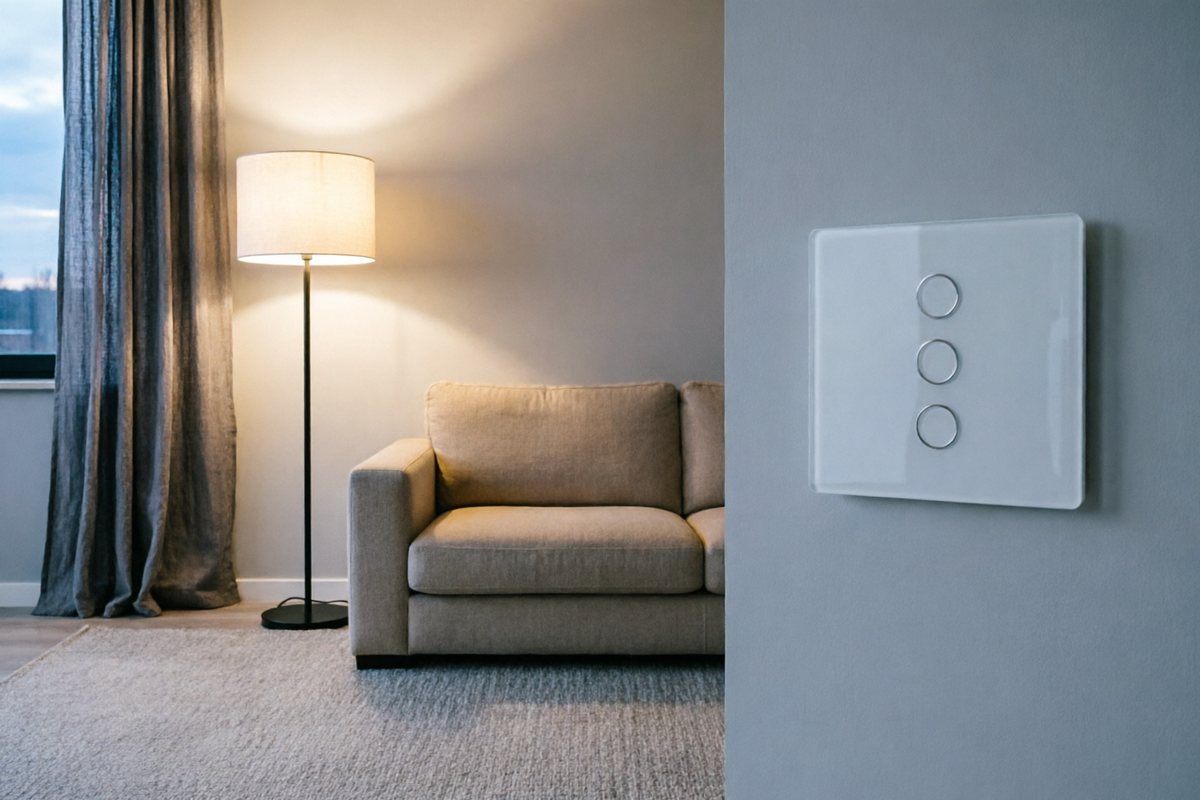
A switch specified for a senior living or assisted-care facility is judged on a different scale than a residential or hospitality panel: can a resident with reduced grip strength, low vision or early-stage cognitive changes operate it without help, every time, without needing to remember an app existed. This is an accessibility brief for developers, operators and facilities buyers writing an RFQ for senior housing, not a general smart-switch overview.
Physical control has to work without the app, every time
The single most important rule for this sector: never assume a resident will use a smartphone app as the primary control. Every switch a resident touches directly needs a reliable physical fallback — a paddle or button that works identically whether the network is up, the app was never installed, or the resident simply does not want to use a phone. App-based scheduling and remote care-staff visibility are valuable additions on top of this, not substitutes for it.
Contrast, size and force — the accessibility basics
Three physical specifications matter more here than in almost any other sector this catalogue covers:
- Visual contrast: the switch face, indicator light and surrounding wall plate should be distinguishable at a glance for residents with reduced vision — ask for the contrast rating on any panel proposed for this use case rather than assuming a dark-on-dark design is acceptable.
- Actuation force: a large-paddle rocker or a low-force touch panel is generally easier for residents with reduced grip or dexterity than a small toggle or a capacitive surface that requires a precise tap.
- Backlit or illuminated indicators: a switch that is findable in a dim room at night reduces fall risk, which is a leading safety concern in this sector.
Caregiver and staff-facing control
Facility staff typically need a way to check or override lighting in a resident's room without walking to the switch — for wellness checks, night rounds, or responding to a call system. Keep this staff-facing layer separate from any nurse-call or emergency alert system in the RFQ conversation: a smart switch platform is a lighting and scene control layer, and PanelLink's role in a project is to source and confirm the switch hardware, not to integrate or certify a facility's clinical call system. State clearly in the RFQ which systems the switches need to sit alongside, and confirm any integration claims directly with the relevant system vendor rather than assuming compatibility.
Wiring and retrofit reality in older facilities
Many senior living conversions happen inside older residential or institutional buildings that were not wired with a neutral line at every switch box. This affects which control technology is realistic per room — see our neutral vs no-neutral guide for what that changes in module selection, and confirm wiring type building by building before finalizing a spec, since a badly matched module is a fall-risk and maintenance issue in this sector, not just an inconvenience.
Standardization across a facility
As with student housing and serviced apartments, keeping one consistent SKU and one consistent panel layout across every resident room reduces confusion for both residents who move rooms and for staff supporting multiple floors. Resist requests to vary finish or button layout room by room; consistency is a usability feature in this sector, not just a procurement convenience.
| Design factor | Recommendation |
|---|---|
| Primary control | Physical paddle or low-force touch, always functional without app |
| Contrast | High-contrast face and indicator, confirmed with supplier |
| Night visibility | Backlit or illuminated indicator |
| Layout | One standard layout across all resident rooms |
What to write in the RFQ
State the resident population's accessibility needs (grip, vision, cognitive load), building age and wiring type, and any adjacent systems the switches need to coexist with. This is a project where over-specifying the accessibility requirements up front saves far more than it costs, given how disruptive a room-by-room retrofit is once residents are in place.
Speccing switches for a senior living or assisted-care project?
Send resident accessibility needs and building wiring notes — our trading desk will confirm a panel that works reliably without an app.
Start RFQAccessibility Specifications With Testable Acceptance
Accessibility claims become specifications when they are written as testable statements. Easy to use is not a specification; switches operable with a closed fist, touch activation at no more than a light press, and no reliance on small on-screen targets is. The same conversion applies to placement: mounting heights stated as measurable ranges, contrast stated as a ratio, illumination of legends stated so a night-shift caregiver can find the right switch without a phone light. Each testable line can be checked on a sample; none can be checked on a brochure.
Involve the care staff in sample review — they know which residents fumble touchscreens, which corridors are dark at three in the morning, and which wall positions get blocked by furniture. One review session typically reorders the specification more usefully than any accessibility guideline, because the guideline describes averages and the facility describes its actual residents. Suppliers with healthcare and senior-living experience will recognize the requirements immediately; the RFQ should name the segment explicitly so the desk routes the proposal to product lines with the larger touch targets, higher contrast legends and simpler logic that this market needs.
The market note closes the case: senior living is growing everywhere the population is aging, and the specification habits this segment teaches — testable accessibility, staff-informed review, honest placement — improve every other line a distributor carries. Buyers who serve this market well find the same discipline lifting their hotel and residential ranges, because a switch a weak hand can operate is simply a better switch for everyone. The segment is not a niche at the edge of the catalog; it is a quality standard wearing a niche name.