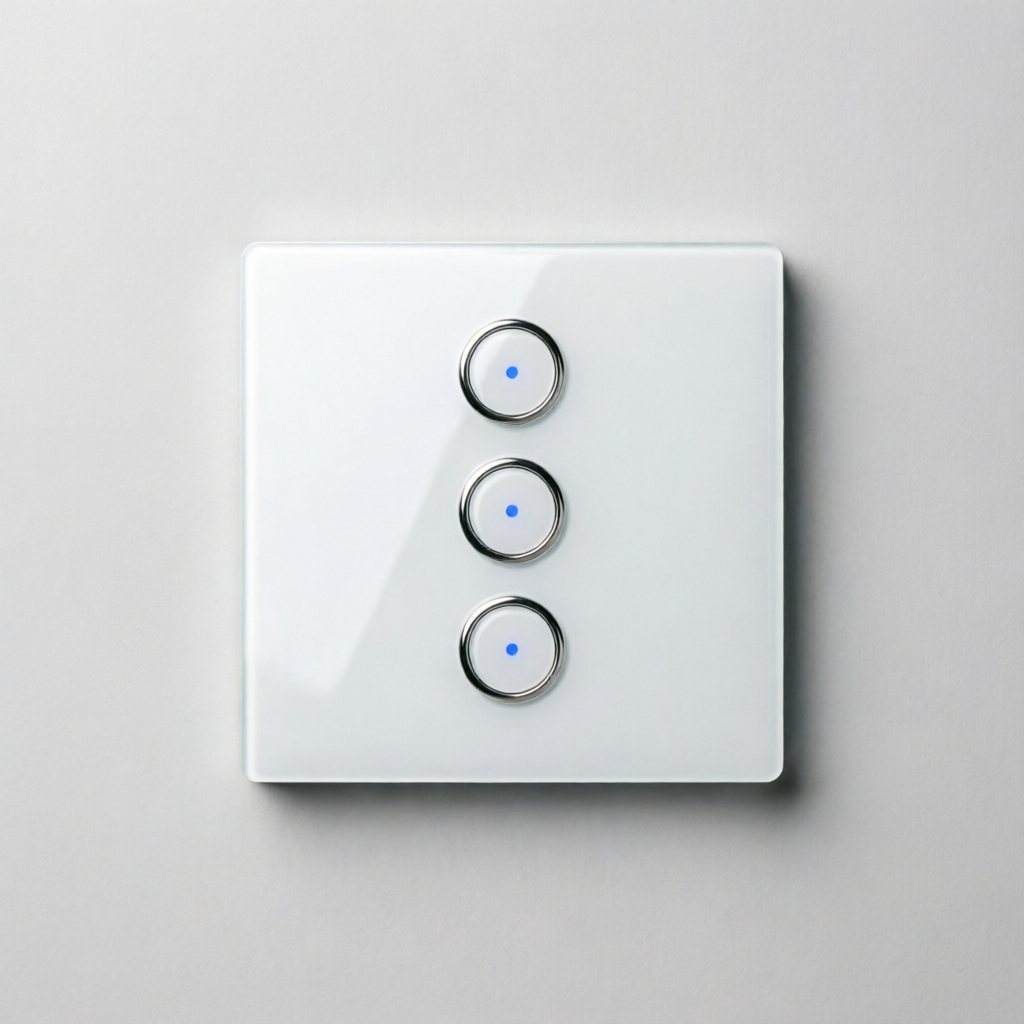
First-time buyers of smart wall switches often anchor their bulk budget on the sample invoice, then are surprised when the per-unit number moves — sometimes down, sometimes up in ways that look inconsistent. It is not inconsistent once the cost structure behind each stage is understood. This guide separates what a sample price is actually paying for from what a bulk price is paying for, so a first order can be budgeted correctly from the start.
What a sample invoice is really covering
A sample run is priced to cover setup and handling on a very small quantity, not to represent the unit economics of a production line. A single-digit or low double-digit sample order typically carries:
- Line setup and changeover time that would otherwise be amortised across thousands of units.
- Individual picking, testing and packing labor per piece rather than batch handling.
- Small-parcel or courier freight instead of consolidated ocean/air freight rates.
- Sometimes a plate or tooling fee if any custom print or color is requested even at sample stage — ask this upfront, as it can dominate a small sample invoice.
Because of this, a sample unit price is not a reliable predictor of bulk unit price in either direction — do not extrapolate a container budget directly from a sample quote without asking for the separate bulk price.
What changes once the order becomes bulk
Bulk pricing amortises the fixed costs above across a much larger run and shifts freight to consolidated shipping. The trade-off is that bulk quantity itself becomes a commitment — MOQ, lead time and payment milestones scale with it. Buyers should ask for a bulk quote at the actual target quantity, not a generic "1,000-piece" placeholder, since real per-unit cost can shift meaningfully between quantity bands.
Where OEM customization changes the math
Any logo print, custom color or packaging change reintroduces a fixed cost — most often a plate fee for glass print or a mould consideration for physical changes — that behaves like the sample-stage setup cost, except now spread across a much larger bulk quantity. This is usually still worthwhile at bulk volume, but it should be quoted as a separate line so it does not get buried inside a per-unit number that is hard to audit later. See OEM / ODM for what is typically customizable and what stays fixed.
A budgeting table for a first order
| Stage | What drives the price | What to ask |
|---|---|---|
| Functional sample | Setup + individual handling, small quantity | Is a print/color plate fee included? |
| Pilot / small batch | Partial line efficiency, still courier freight likely | Confirm real bulk quote at this size |
| Bulk / container | Line efficiency + consolidated freight | Quote at your actual target quantity |
| OEM print/pack add-on | Plate fee, insert languages, box tooling | Get this as its own line item |
Cash flow and payment milestones
Beyond unit price, budgeting a first order means planning payment milestones — typically a deposit at PO confirmation, a balance before or at shipment, and sometimes a separate small payment for sample or plate fees earlier in the cycle. Confirm this schedule in the RFQ stage so the finance side of a first order is not a surprise once the factory side is already locked. Our trading desk will confirm payment structure based on your specific order in the RFQ, since terms vary by factory and quantity.
What to put in the RFQ
State target bulk quantity (not just sample quantity), whether OEM print/color is required, destination market for freight planning, and ask explicitly whether the sample quote includes any one-time fees that will not repeat at bulk. Review the product catalogue for SKU-level starting points before sending quantities.
Budget your first order properly
Send us sample and target bulk quantities together — our trading desk will separate one-time fees from true per-unit cost in the quote.
Start RFQWhat the Sample Round Is Actually Buying
Sample rounds look expensive per unit and cheap per decision. The sample stage is where print quality, glass finish, touch feel, app onboarding, packaging strength and certification paperwork all become physical facts instead of catalog claims. Budgeted honestly, samples are priced as information: the round that saves one bulk production mistake has paid for itself several times. Buyers who treat sample fees as an obstacle tend to compress the stage; the compressed stage is where the costly surprises originate.
Two habits make sample spending efficient. Order the sample set as a decision package — the SKU plus its packaging proof plus any paired products such as a gateway or sensors it will ship beside — so approvals happen on the combination, not the part. And define acceptance criteria in writing before the samples ship: what gets tested, what passes, who signs. A defined sample round usually finishes in one iteration; an undefined one wanders through three. Your RFQ should state both, and a consolidating desk will structure the sample package across factories so the decision arrives as one coordinated set rather than five separate envelopes.
Budget the decision round with an explicit acceptance deadline too. Samples that arrive without a decision date drift into background tasks, and drift is where sample momentum dies. A dated review on the calendar — one week after the samples land, attendees named — keeps the approval moving at the pace the production slot assumes. Suppliers schedule around buyers who decide; the reorder terms reflect it, and the launch date survives its own paperwork.