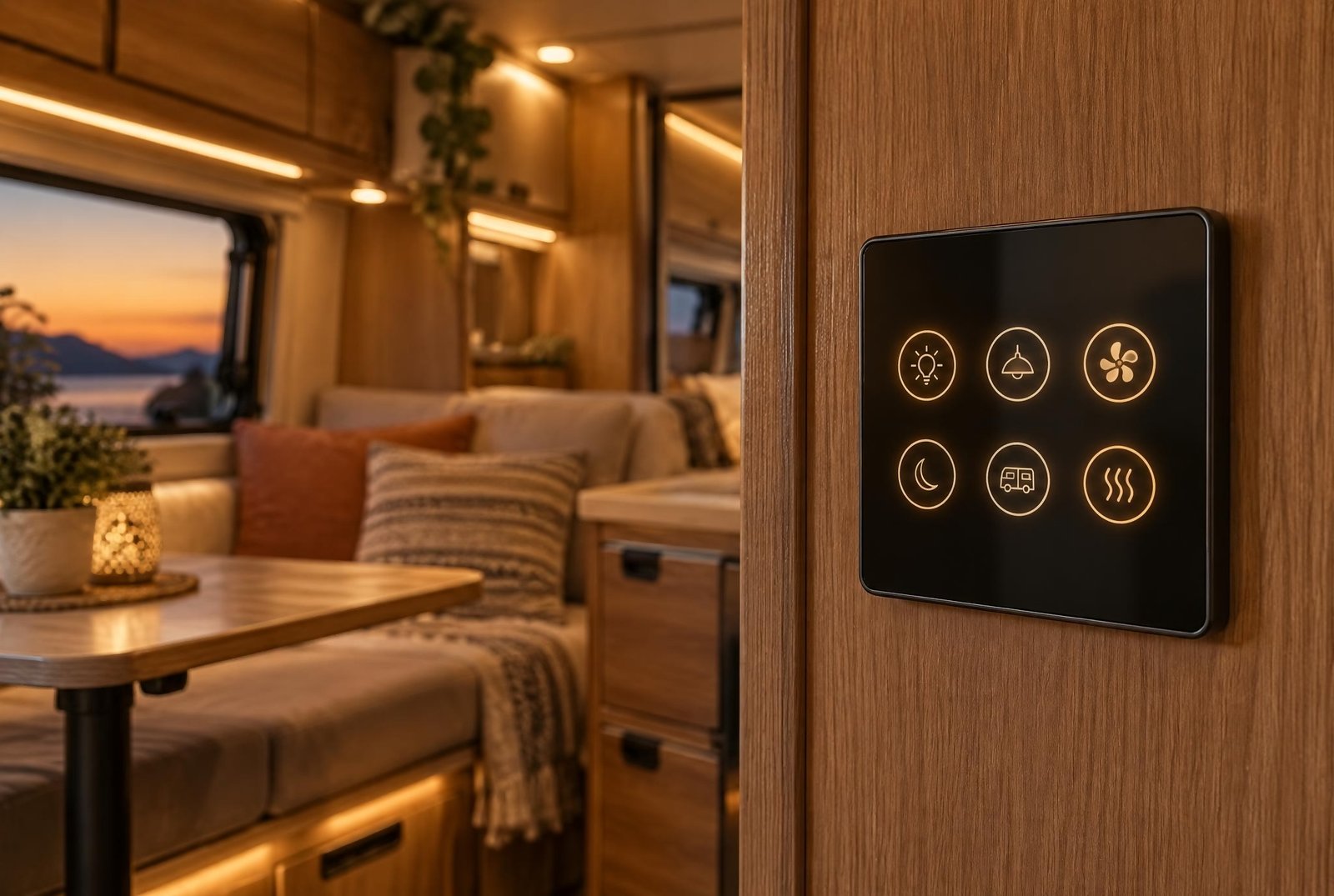
Campervan and motorhome conversions live or die on interior finish, and nothing dates a build faster than a wall of mismatched rocker switches wired directly to the house battery. The 12V touch panel solves that in one product: a glass multi-gang interface that switches lighting, water pumps, fans and accessory circuits from a single location, with backlighting that doubles as night lighting in a dark van. For professional converters and RV OEMs the question is not whether to standardise on such panels but which specification to buy — and the decisions that matter are load mapping, wiring distance, gang layout and branding consistency. This article walks through each for B2B buyers building vans in series, whether that series is ten vehicles a year or ten thousand.
The 12V house system, briefly
Every RV has two electrical worlds. The chassis system starts the engine and runs 12V vehicle functions. The house system — the part converters care about — is its own battery, charged from the alternator, from solar or from shore power, and feeds everything the occupants touch: interior lighting, LED strips, water pumps, roof fans, heater controls, fridge electronics and USB charging. A 12V touch panel belongs entirely to the house side. It switches the positive leg of each house circuit, the return runs to the house negative bus, and no mains neutral or grid connection is involved anywhere. This is why the same panel cannot simply be "converted" from a residential wall switch: the source, the loads and the protection model are all different, as explained in our comparison of 12V DC and mains smart switches.
Mapping house loads to panel channels
The core document in any conversion programme is the load list: one line per circuit, naming the load, its behaviour and where the user expects to control it. Typical house circuits include:
- Lighting — ceiling lights, spotlights, under-cabinet and cove LED strips, awning and entry lights, often grouped so several zones switch together.
- Water system — the freshwater pump is the classic motor load in a van; it cycles automatically with a pressure switch in many builds, and the panel channel is usually an enable/isolate switch rather than the raw pump feed.
- Ventilation and climate — roof fan speeds, diesel or gas heater enable circuits, fridge isolation for transport.
- Accessories — inverter remote-on, step and awning actuators, exterior work light, rear-camera monitor power.
Two habits keep this list honest. First, separate lighting channels from motor channels in the specification, because motor loads carry inrush current and belong behind relays or on channels explicitly rated for motor duty — the exact per-channel rating is a datasheet figure to confirm in writing. Second, decide early which loads are switched at the panel and which merely indicated from it; a pump that the heater logic also controls should not be wired in a way that lets a panel switch fight another controller.
Voltage drop: the van-specific problem
A campervan is long and narrow, and the house battery often sits at one end while the bedroom lighting sits at the other. Voltage drop over that run is the most common cause of disappointing DC installs: lighting that looks dim, fans that start slowly, panels that reset when a heavy load kicks in. The remedies are standard practice — adequate wire gauge for the run and the current, shorter runs where the layout allows, and relays mounted near heavy loads so the panel carries only control current. A practical check is to measure voltage at the panel and at the load under real operating conditions, not just with everything off. Buyers who write the expected run lengths and load types into the RFQ get panels and wiring plans that survive contact with a real vehicle; the wiring-side details are covered further in DC circuit considerations for 12V touch panel installations.
Gang layouts, mounting and form factor
Unlike stationary buildings, vehicles offer awkward wall depths and curved or thin panels, so the physical format deserves as much attention as the electronics. Multi-gang touch panels reduce the number of wall positions and wiring runs — one central four- or six-gang panel at the entry is common, with a two- or three-gang unit at the bedside. Our gang configuration guide explains the trade-offs in general terms. Check in the specification: mounting depth behind the panel versus wall thickness, whether the frame needs an adapter plate for the wall material, and how the unit is secured so road vibration cannot work it loose. For semi-permanent wall cavities in motorhomes, the same panel families used in marine helms often fit well, since they are built for vibration — see the parallel guide on marine 12V touch panels.
Labelling, backlight and the user experience
In a residential switch, an unlabelled gang is a minor annoyance. In a rental campervan it is a support ticket, because guests will experiment with every circuit to find the water pump. Converters running fleets should therefore treat legends and backlighting as core specification items: channel names printed or engraved to match the vehicle's circuit list, backlight colour consistent across the whole vehicle, and dimming behaviour that does not keep guests awake at night. Custom legends are a normal OEM request and typically cost little when ordered with the panel rather than added later — confirm legend options and tooling in your RFQ.
Ordering for a conversion programme
Small one-off builders buy panels retail. Conversion shops buying in series should instead treat the panel as a component with its own part number, and put the following in the RFQ: gang count and channel-to-circuit mapping, load types per channel, system voltage, wall depth and mounting method, legend artwork, backlight colour, and branding across face, packaging and installation instructions. As a trading platform with 40+ partner factories, 8000+ SKUs and 12 years of export experience, we consolidate DC panels with the rest of a vehicle fit-out — sockets, sensors, lighting — into one shipment with consistent packing lists, which is how fleet buyers keep variants straight across a model year. State the full requirement once in the RFQ form and let the sourcing desk return matched options with rated figures confirmed in writing.
Quick specification table
| Decision | Typical converter choice |
|---|---|
| Entry / galley position | 4-6 gang panel, lighting plus pump enable |
| Bedroom position | 2-3 gang, dimmable lighting and fan |
| Motor loads | Relay-driven, panel carries control current |
| Backlight | Warm or amber tone, dimmable, uniform per vehicle |
| Legends | Custom printed to the fleet's circuit list |
| Ordering | One panel part number across the model year |
Standardising panels across a van programme?
Send the load list, wall depths and legend requirements in one RFQ — we return matched DC panel options with confirmed ratings for your model year.
Start RFQ