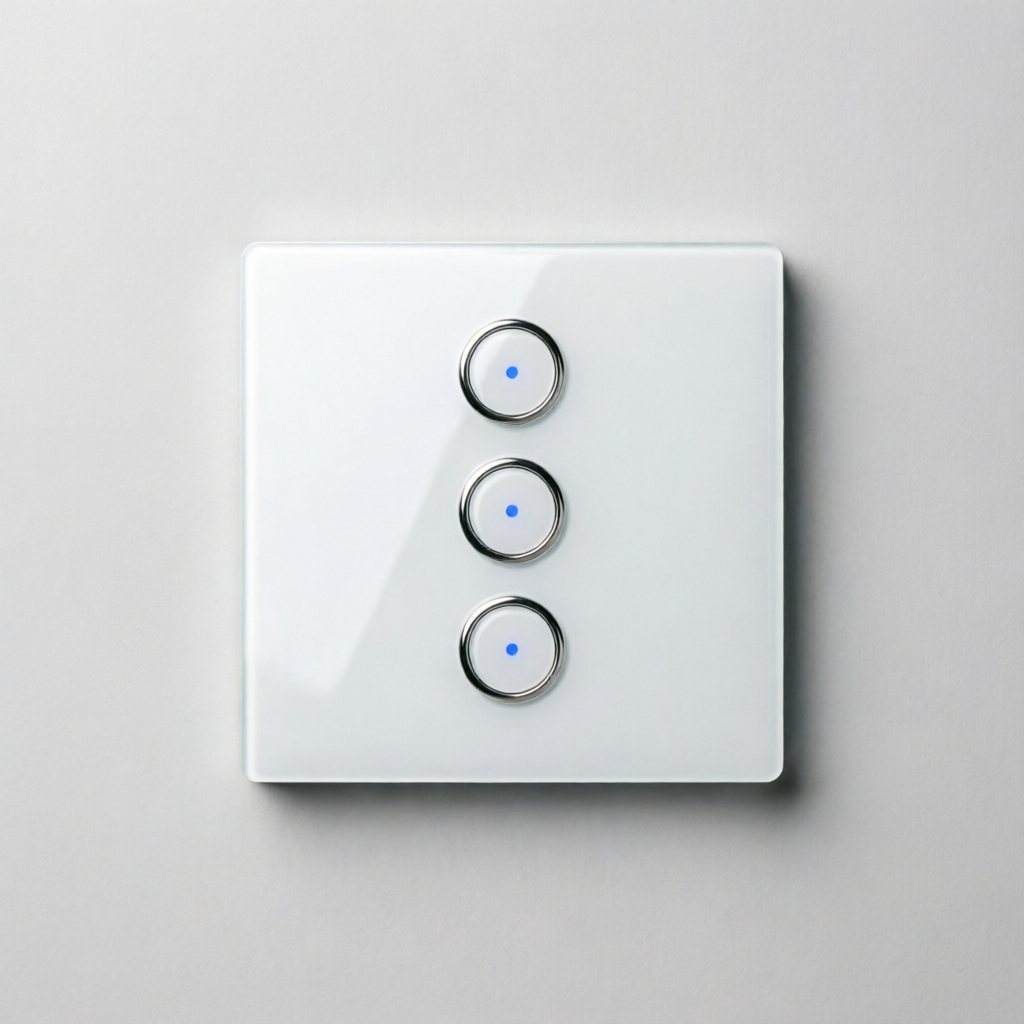
Put a mains smart switch and a 12V DC touch panel side by side and most buyers see the same product: a tempered-glass face, capacitive buttons, backlighting, a wall plate. Everything that matters for sourcing, however, is decided by the one thing the two products do not share — the electrical system behind the wall. Mains switches are defined by the public grid: fixed household voltage, live and neutral conductors, certification regimes built around grid safety. 12V panels are defined by a battery: mobile, isolated from the grid, with loads and protection rules of their own. Treating these as one category with a voltage option is the most common specification error we see from new buyers, and this article sets out exactly where the products diverge so an RFQ can be written for the right one.
The source changes everything: grid versus battery
A mains switch is wired between the grid's live conductor and the load, with neutral completing the circuit; that is why the presence or absence of a neutral wire at the box is a defining constraint in residential retrofits, as covered in our neutral vs no-neutral guide. A 12V panel is wired into an isolated DC system — a boat's house battery, a van's auxiliary battery, a vehicle's accessory feed — and switches the positive leg of each circuit back to a negative bus. Three consequences follow. First, there is no "no-neutral" problem in DC: the battery supplies both rails by design. Second, the product must tolerate the DC system's reality, including charging transients and voltage that sags under heavy load rather than staying at a fixed grid value. Third, safety practice is different: the DC system is lower voltage and therefore less dangerous to install, but it is also unfused-per-circuit only if the installer makes it so — protection discipline lives or dies at the fuse block, as described in our DC circuit considerations article.
Loads: appliance circuits versus accessory circuits
Mains switching exists to control wall-powered appliances — lighting, fixed appliances, sockets — where each circuit is engineered to a grid standard and the switch's job is clean disconnection of an AC load. 12V panels control a different zoo: LED strips, pumps, fans, compressors, actuators and electronics on a vehicle or vessel. The load behaviour differences are practical, not academic. DC motor loads draw inrush current at start and are the usual reason a panel channel fails early when misapplied. High-current DC loads are normally moved behind relays, with the panel carrying only control current. And because these systems are hand-built rather than grid-installed, the panel specification includes wiring guidance — legends, wiring diagrams, fuse recommendations — that a mains product in a regulated market rarely needs to ship with. When comparing quotations, check that per-channel ratings are quoted against your actual load list, not a generic figure; the rated current is a datasheet number to confirm in writing for each product family.
Why the relay and electronics differ, not just the wire
Inside the panel, the switching element sees a different electrical problem. AC current crosses zero many times per cycle, which naturally extinguishes the arc that forms when contacts open; DC has no zero crossing, so an arc across opening contacts can persist and erode them unless the switch or relay is rated for DC breaking. This is one reason a relay's DC rating is typically far lower than its AC rating for the same physical part, and why serious 12V panel designs specify DC-rated relays and move heavy loads to external ones. The electronics differ too: a mains smart switch derives its low-voltage supply from the grid through an internal power supply, while a DC panel runs from the battery rail it controls and must therefore watch its own quiescent draw — on a moored boat or a parked van, every milliamp counts against the battery. Ask suppliers about standby consumption and low-voltage behaviour for battery applications; both are legitimate RFQ line items even though exact figures come from the datasheet.
Certification and market pathways
Mains products in most export markets need grid-oriented approvals — safety and EMC regimes such as CE in Europe, with market-specific additions elsewhere, all covered in our certifications section. DC panels for vehicles and vessels generally follow different or lighter pathways, and requirements vary by market, application and whether the product is sold as a component to vehicle builders or direct to end users. The practical advice is the same either way: do not assume that an approval earned by a mains switch family transfers to a DC panel family, or the reverse. State the destination market, the application and the sales channel in the RFQ, and ask the factory or trading desk to confirm which certificates exist for the specific product, with reports you can read before shipment.
Which buyers need which product
| Dimension | Mains smart switch | 12V DC touch panel |
|---|---|---|
| Source | Public grid, fixed household voltage | Onboard battery, isolated system |
| Typical buyer | Distributors, developers, hotel projects | Boat builders, RV converters, upfit brands |
| Loads | Appliance and lighting circuits on the grid | LED, pump, fan and accessory circuits |
| Wiring constraint | Neutral availability at the box | Fusing, wire gauge and voltage drop over runs |
| Heavy loads | Rare at the switch itself | Normally moved behind relays |
| Certification pathway | Grid safety and EMC regimes | Application- and market-dependent, confirm per order |
Channel strategy follows the same split. Retail and distribution businesses stocking mains smart switches rarely need DC panels except as a niche line, while vehicle-oriented brands may need both: DC panels for the vehicle and mains products for the customer's home. Because both families come from the same manufacturing regions — Guangdong and Zhejiang are the two major smart switch and panel manufacturing clusters in China — a single sourcing partner can often cover both lines with clear BOM separation.
How to keep the two straight in procurement
The safeguard is procedural, not technical. Give the two categories different line items, different part numbers and different RFQ templates from day one: the mains template asks about grid voltage and frequency by destination market — see our guide on voltage and frequency specifications — while the DC template asks about system voltage, load list per channel, relay architecture and mounting environment. Mixing them produces quotations that look comparable and are not. If a project genuinely needs both — a marina with shore-power buildings, or an RV dealer also fitting customer homes — keep the split visible through delivery, right down to separate packing lists, so installers never receive a mains switch where a DC panel was specified.
Need both categories, cleanly separated?
Send your mains and DC requirements as separate lines in one RFQ — our desk returns matched products with ratings, certifications and packing lists kept apart.
Start RFQ