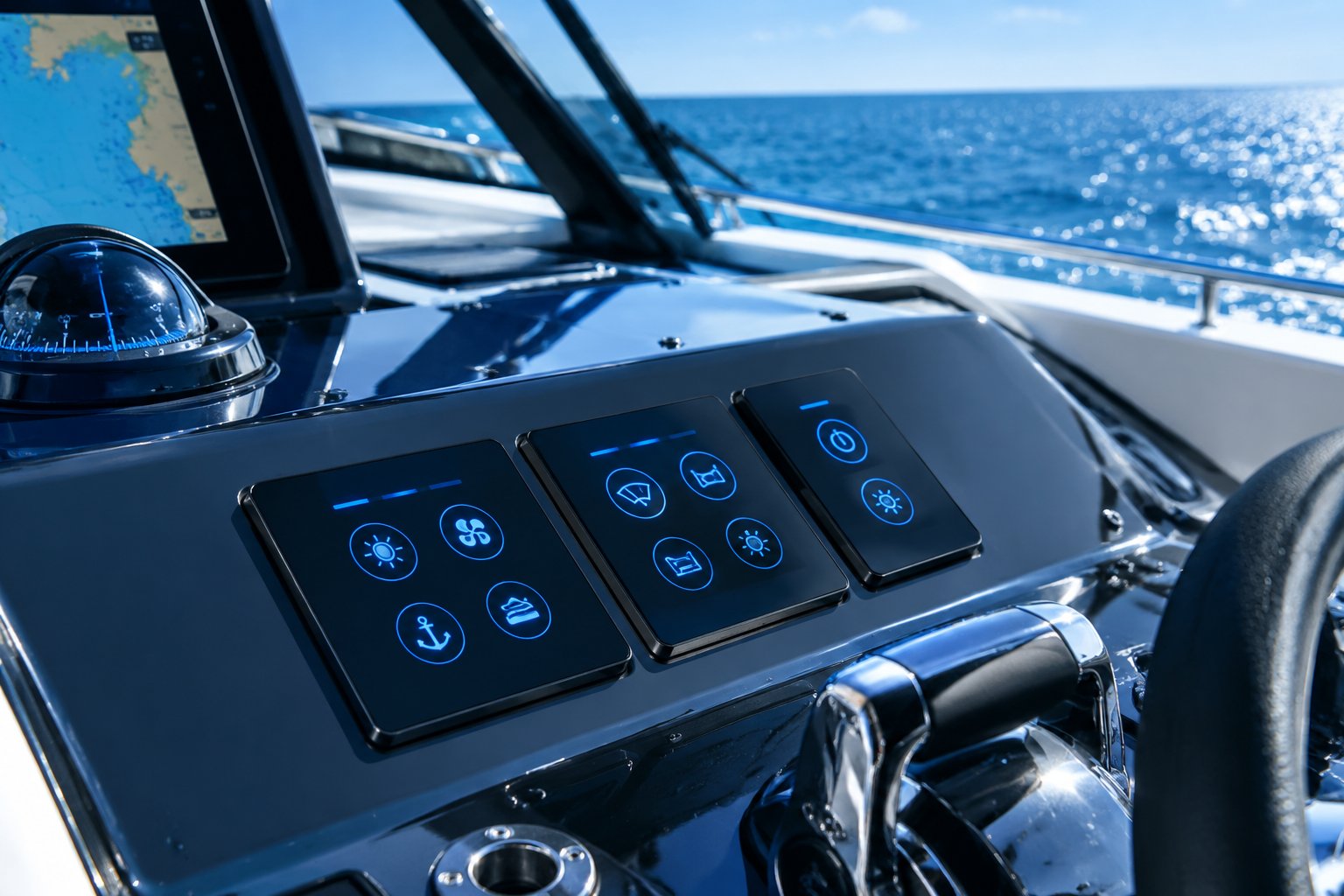
A boat is one of the few places where an entire building's electrical logic flips: there is no utility grid behind the panel, only a battery bank, an alternator or shore charger, and a set of DC circuits that all have to be switched, fused and labelled. That is why 12V touch switch panels have become a standard fixture at helm stations and cabin entrances — they gather what used to be a scattered cluster of rocker switches into one tempered-glass interface, with backlighting for night operation and clean labelling for guests and crew. This guide is written for boat builders, refit yards and marine distributors sourcing panels in volume. It concentrates on the questions that decide whether a panel survives salt, vibration and moisture, rather than only how it looks in a catalogue.
Why marine switching is a DC problem
Mains wall switches are designed around an AC grid with live and neutral conductors and protective earth. A vessel at anchor has none of that: the source is the house battery, loads wire back to a DC negative bus, and every circuit is defined by which positive feed it draws from. A 12V touch panel therefore does not sit between live and neutral the way a residential smart switch does — it switches the positive leg of each DC circuit, and the return path runs through the vessel's negative bus. That single difference rewrites the specification conversation. Instead of asking "which country's grid is this for", the buyer asks "which battery system, which load on each channel, and what protection sits upstream". The broader logic is covered in our overview of 12V and DC touch panels.
The load profile differs from a home as well. A marine panel typically controls navigation lights, anchor lights, cabin and cockpit lighting, LED strips, freshwater and bilge pumps, blower fans, windscreen wipers, horn circuits and USB charging feeds — a mix of lighting and motor loads behind one interface. Motor loads are the demanding part: pumps draw a startup current well above their running current, so a channel sized only for steady-state lighting will not last next to a pump. Serious marine RFQs therefore list the load type for every channel, not just a total wattage figure.
Matching panel channels to real boat loads
The most reliable specification method is to walk the boat circuit by circuit and write down, for each one, what the load is and how it behaves. A practical mapping looks like this:
- Lighting loads — nav lights, anchor light, cabin lights, courtesy strips. Low current, long run times, and the loads most users notice dimming first when voltage drop creeps in.
- Motor loads — bilge pump, livewell pump, freshwater pump, blower fans. Inrush current on start, so these channels should either be relay-driven or explicitly rated for motor duty; the exact per-channel rating is a datasheet figure to confirm in writing, not to assume.
- Safety-critical circuits — bilge pump and nav lights in particular. Many builders keep these on dedicated circuits with their own fusing so that a fault elsewhere never takes them offline.
- High-draw accessories — windlasses, inverters, large wipers. These usually belong behind a relay or solenoid, with the touch panel carrying only the control signal rather than the full load current.
That last point is the single most useful habit for marine buyers: treat the touch panel as a control and indication surface, and push heavy current out to relays near the loads. The panel then lasts longer, runs cooler, and a relay replacement is a five-dollar part instead of a panel swap.
The salt, moisture and vibration environment
Marine installations are harder on electronics than most residential ones, and the difference shows up in three places. First, moisture and salt: panels mounted near companionways, in heads or at open helms see spray and condensation, so sealing quality, gasket design and the ingress protection rating of the assembled panel all matter — and since ratings vary by construction, the specific IP figure should be stated and confirmed in the RFQ rather than assumed from a product photo. Second, vibration: a planing hull transmits engine vibration into every fixed surface, so connector retention, screw terminals versus push-fit wiring, and how the rear housing mounts all influence whether a panel develops intermittent faults in its second season. Third, UV and cleaning chemicals: bezel and face materials that look identical indoors can yellow or craze under cockpit sun exposure, which is why tempered glass faces are generally preferred over plastics for exposed marine positions.
Night operation is the fourth environmental factor buyers sometimes forget. Backlighting colour and dimming behaviour matter to crews running at night, and legends must stay legible when backlit. If the panel supports custom printed or engraved legends, this is the moment to lock the channel names — "BILGE", "NAV LTS", "WATER PUMP" — into the order rather than relabelling on site.
Circuit protection and wiring discipline
A marine DC panel is only as safe as the distribution behind it. Each circuit should be fused close to the battery or house bus, sized for the wire protecting it, and the panel itself should specify how its own inputs are protected. Wiring practice matters just as much: voltage drop over long runs in a hull is a real effect, thin or undersized wire shows up first as dim lighting and slow pumps, and every additional connector is a future corrosion point in a salt environment. Where a run is long or a load is heavy, the answer is thicker cable and a relay, not a bigger fuse — a fuse is there to protect the wire, and upsizing it to mask nuisance blowing only moves the failure somewhere less convenient. For a fuller treatment of these wiring questions, see our article on DC circuit considerations for 12V panel installations.
What to write in a marine panel RFQ
Marine RFQs fail in predictable ways: the buyer asks for a "4-gang 12V panel" and leaves the loads, the environment and the legends undefined, so samples arrive that look right and behave wrong. A complete request covers:
- Number of gangs and the load list per channel (lighting, motor, or relay control only).
- System voltage (12V, or 24V on larger and commercial vessels — many heavy and commercial boats run 24V systems) and whether both variants are needed.
- Ingress protection expectations for the mounting position, and any marine-specific approvals your market requires.
- Backlight colour, dimming behaviour and legend artwork per channel.
- Terminal type, rear housing material and mounting method for the vibration environment.
- Branding: private-label faces, packaging and documentation for boat-builder programmes.
As a trading platform working with 40+ partner factories and 12 years of export experience, we see the pattern repeat: buyers who state loads and environment up front get usable first samples; buyers who don't, pay for a second sample round. If your line includes other DC or mains switching products, our team can consolidate them into one shipment — see the product catalogue and OEM/ODM pages for context.
Final checklist before you order
| Item | Confirm before ordering |
|---|---|
| Per-channel rating vs real load | Datasheet figure in writing, especially for pump channels |
| Ingress protection | Stated figure for the assembled panel, matched to mounting position |
| Vibration durability | Terminal type and mounting method suitable for a hull |
| Legends and backlight | Artwork locked at order time, legible when backlit |
| Upstream protection | Fuse per circuit near the bus, panel protection defined |
| Approval requirements | Market-specific requirements stated in the RFQ |
Sourcing 12V panels for a boat programme?
Send us the load list, mounting positions and branding requirements — we will match the panel spec and confirm every rated figure in writing before samples ship.
Start RFQ