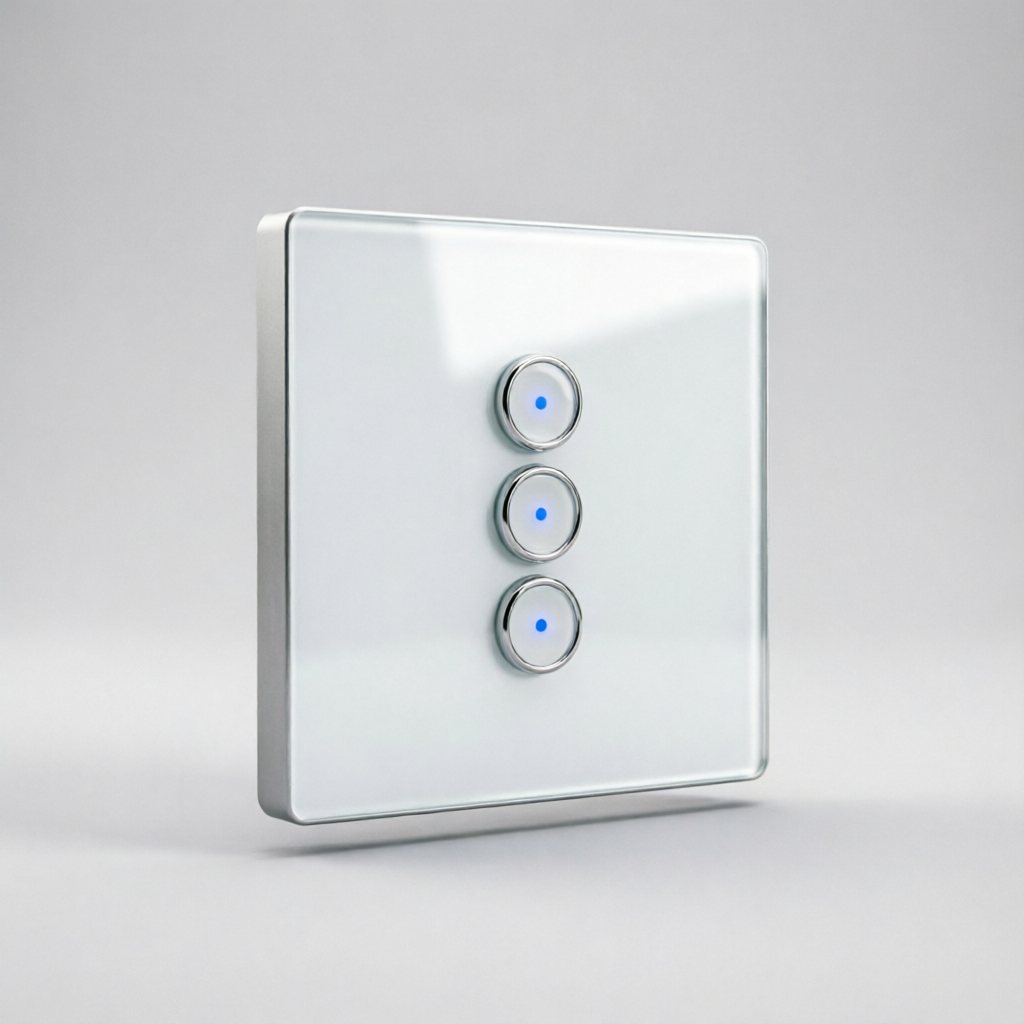
Most sample testing for smart switches stops at "does it turn on and pair to the app." That is a fraction of what actually fails after a bulk order ships. A proper sample test cycle checks electrical performance, mechanical durability, network behavior and packaging together — the same four layers that cause returns once a batch is in the field. This is the checklist worth running before, not after, a production commitment.
Why the datasheet is not enough
A datasheet states rated values under defined conditions; it does not tell you how a switch behaves at the edge of its Wi‑Fi range, how consistently ten units from the same batch pair to the app, or how the touch panel holds up under repeated use. Sample testing exists precisely to catch what a spec sheet cannot show — see our companion guide on reading a datasheet like a sourcing manager for what the paper claims should be cross-checked against.
What to test on samples, by category
- Electrical. Confirm rated voltage and frequency operation, load handling for the switch type (relay-based vs no-neutral capacitor-drop designs), and standby power draw.
- Mechanical. Check touch or rocker actuation feel, panel material finish, and repeated-cycle durability if the supplier can provide cycle-test data.
- Network and app. Pair multiple sample units to the same app account and confirm consistent behavior — naming, scene assignment, offline/online reporting — not just a single successful pairing.
- Firmware. Trigger an OTA update on a sample if possible and confirm the device recovers cleanly; this is the single most under-tested step and the one most tied to the failures covered in our firmware update guide.
- Packaging. Test the retail or bulk packaging under a simulated shipping stress, not just visual approval of the box design.
How many samples and rounds makes sense
A single sample confirms a design exists; it does not confirm batch consistency. Requesting a small multi-unit sample set — enough to check unit-to-unit consistency in pairing and finish — is generally more informative than one perfect unit, and a second round after any requested changes is worth the extra week before a large PO. Exact sample quantities, lead times and costs vary by supplier and order size, so confirm those specifics in your RFQ rather than assuming a standard figure.
Sample-to-bulk consistency checks
| What to compare | Sample vs first bulk shipment |
|---|---|
| Firmware version | Confirm it matches what was tested in samples, not a newer untested build |
| Hardware revision | Confirm no silent component substitution between sample and bulk run |
| Certification marks | Confirm bulk units carry the same certification marks as the approved sample |
| Packaging | Confirm bulk packaging matches the tested sample packaging, not a cost-reduced version |
Building this into your RFQ
State clearly in the RFQ that sample approval is a condition of bulk production release, and ask the supplier to confirm in writing that bulk units will match the approved sample on firmware version, hardware revision and packaging. This is a standard, reasonable ask — a supplier that resists documenting it is worth a second look.
Planning a sample round before your next PO?
Tell us your test priorities and timeline — our trading desk will help structure a sample cycle that catches issues before bulk production.
Start RFQA Sample Test Script You Can Run in an Afternoon
Sample testing earns its cost when it is scripted. The afternoon version: pair every unit to the app from a cold start, timing the flow and noting every screen; operate each switch through twenty cycles listening for relay consistency; press touch zones corner to corner; read the plate under daylight and under lamplight for print quality; load the rated wattage through one gang and feel for heat after an hour; reset one unit to factory and pair it again, verifying the documented reset works. Each step has a pass or fail you can write down, and the written sheet becomes the approval record.
Add the environment your market actually supplies. If destination walls are concrete with shallow boxes, test in one. If your market's phones are predominantly one ecosystem, run onboarding on that device first. Test the packaging by the journey, not the shelf — a drop or a compression check on one inner carton tells you what the container will do to your glass faces. The script costs an afternoon; the bulk order it protects is measured in container loads. Factories respect buyers with scripts, because a scripted test tells them the approval will be objective and the reorder will follow.
Keep the completed test sheets with the samples themselves — taped to the retained units or filed beside them. Six months later, when a field question arrives about exactly the behavior you tested, the sheet answers with a date, a method and a result instead of a memory. Distributors who retain sample-and-sheet pairs build a reference library that answers disputes, supports marketing claims and trains new staff; the library begins with one afternoon and one script, which is why the afternoon is the cheapest quality investment in the entire sourcing calendar.
One test belongs at the very end of the script, and it is the easiest to skip: repeat the pairing and basic operation on a second and third unit, not just the first. Production spreads — a marginal touch zone on one unit, a slightly stiff relay on another — are exactly what a single-unit test misses and exactly what a bulk order multiplies. Three units through the script triple the confidence for a few extra minutes, and the cost of the habit is trivial next to the variation it catches.