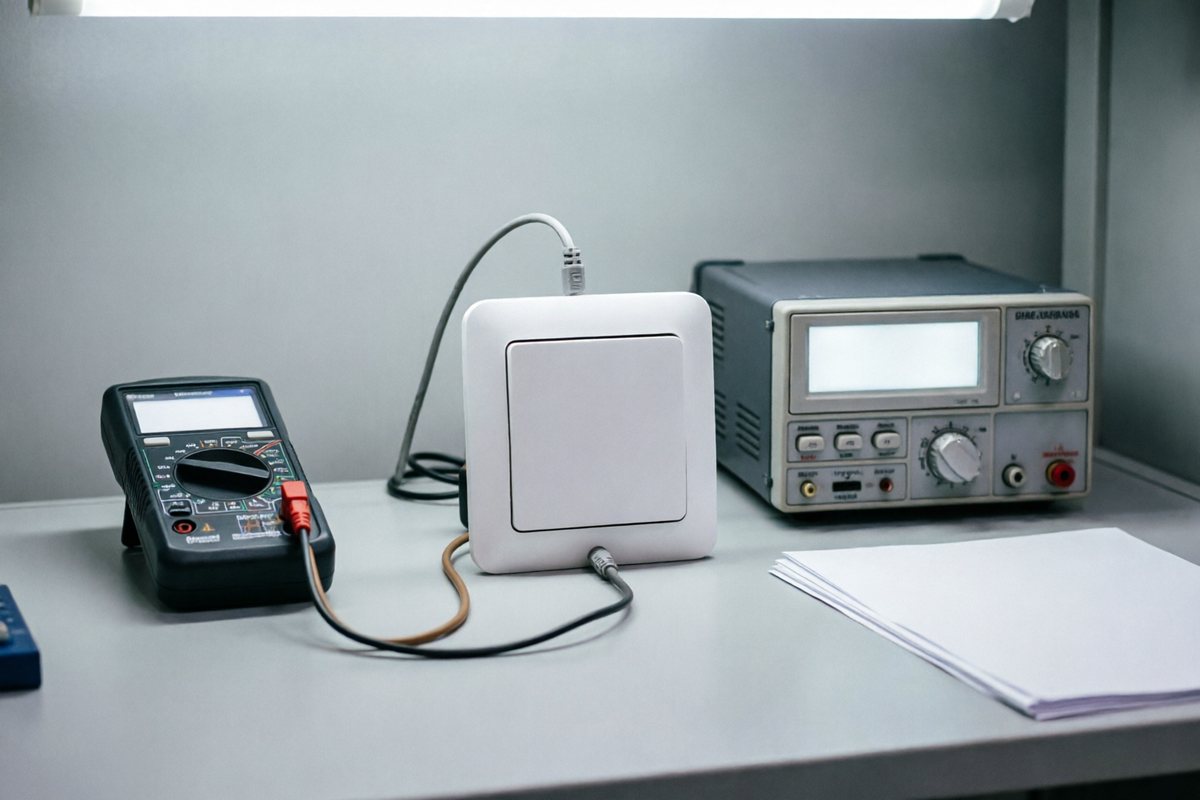
A CE mark printed on a switch's back plate or its retail box is the most commonly cited certification in smart switch RFQs, and also the most commonly misunderstood. It is not issued by a single authority after an independent inspection the way some buyers assume. It is a manufacturer's own declaration that the product meets a specific set of EU directives — which means the mark is only as trustworthy as the paperwork behind it, and that paperwork is exactly what a B2B buyer should be asking to see.
What CE actually is
CE marking is a conformity declaration, not a product-specific test certificate from a regulator. For a smart wall switch, the relevant directives typically include the Low Voltage Directive (LVD, electrical safety), the Electromagnetic Compatibility Directive (EMC), the Radio Equipment Directive (RED, for any device with a Wi‑Fi, Bluetooth or Zigbee radio) and the RoHS Directive on restricted substances. The manufacturer — or an EU-based importer acting as "manufacturer of record" — self-declares conformity to all applicable directives and signs a Declaration of Conformity (DoC) referencing the test reports that support that declaration. There is no CE certificate as such; there is a DoC backed by test reports, and that is the actual document a buyer should request.
Why "has CE" is not, by itself, an answer
- The DoC is specific to a model and hardware revision. A different gang count, a different radio module, or a later firmware/hardware change can mean the existing DoC no longer covers the product you are actually ordering.
- Self-declaration means the factory or brand owner carries legal responsibility for the accuracy of the claim — a buyer importing under their own name inherits real exposure if the underlying test reports do not actually support the declaration.
- A printed CE logo on a sample unit proves nothing on its own; it is the DoC and the referenced LVD/EMC/RED test reports that constitute evidence.
What to request before you accept "CE certified" in a quote
- The Declaration of Conformity itself, naming the exact model number and hardware revision you are ordering.
- The LVD and EMC test reports it references, and — for any radio-equipped switch — the RED test report covering the wireless module as installed in the finished device.
- Confirmation of who is named as manufacturer or authorised representative on the DoC, since that is the entity carrying regulatory responsibility in the EU market.
- Whether a notified body was involved (not required for most low-risk categories under self-declaration, but relevant if your specific product category requires it).
CE and the UK market in 2026
Buyers selling into the UK sometimes assume CE alone is no longer sufficient. As of 2026, the UK still recognises the CE mark for the majority of product categories, covering 21 key regulations, and most experienced sellers continue to lead with CE rather than switching entirely to UKCA. Northern Ireland has its own requirement under the Windsor Framework that products carry a CE mark — UKCA alone is not sufficient there. The distinctions are detailed enough that they deserve their own treatment; see our companion article on UKCA versus CE for the destination-by-destination breakdown.
Where this fits in a full document pack
CE is one line in a broader certification conversation that, depending on destination, also covers FCC, UL, RoHS and country-specific marks. See the Certifications page for the site's full capability map, and state your destination market and channel (retail, project, marketplace) clearly in the RFQ so the correct document set can be confirmed rather than assumed.
Need the DoC and test reports for a specific SKU?
Name the model and destination market in your RFQ — our trading desk will confirm the exact document pack available for that SKU.
Start RFQThe Documents Behind the Mark
CE is not a single certificate but a file of documents, and knowing the pieces makes you a harder-to-mislead buyer. The core is the Declaration of Conformity, signed by the manufacturer, listing the directives applied — for a Wi-Fi smart switch typically the Low Voltage Directive, EMC Directive, Radio Equipment Directive and RoHS. Behind the DoC sit test reports from accredited laboratories covering safety and EMC, and the technical file the manufacturer must keep available.
When you request CE documents from a supplier, ask for all three layers by name. A DoC alone proves nothing except that someone typed one; reports without a matching DoC may belong to a different module revision. Match the product name, model number and — where stated — the radio module identity on every page. Mismatches between the module in the report and the module in your sample are among the most common findings when distributors finally audit their files, and they are far cheaper to catch at quotation stage than after the goods land.
A closing note for multi-market buyers: the discipline of document matching transfers across schemes. Whether the file is European, British, American or Middle Eastern, the same three questions apply — which product revision, which laboratory, which date. Buyers who internalize those questions for CE find every other certification conversation shorter, because the structure of compliance evidence is universal even when the marks are not. The mark on the plate starts the conversation; the file behind it is what closes it.