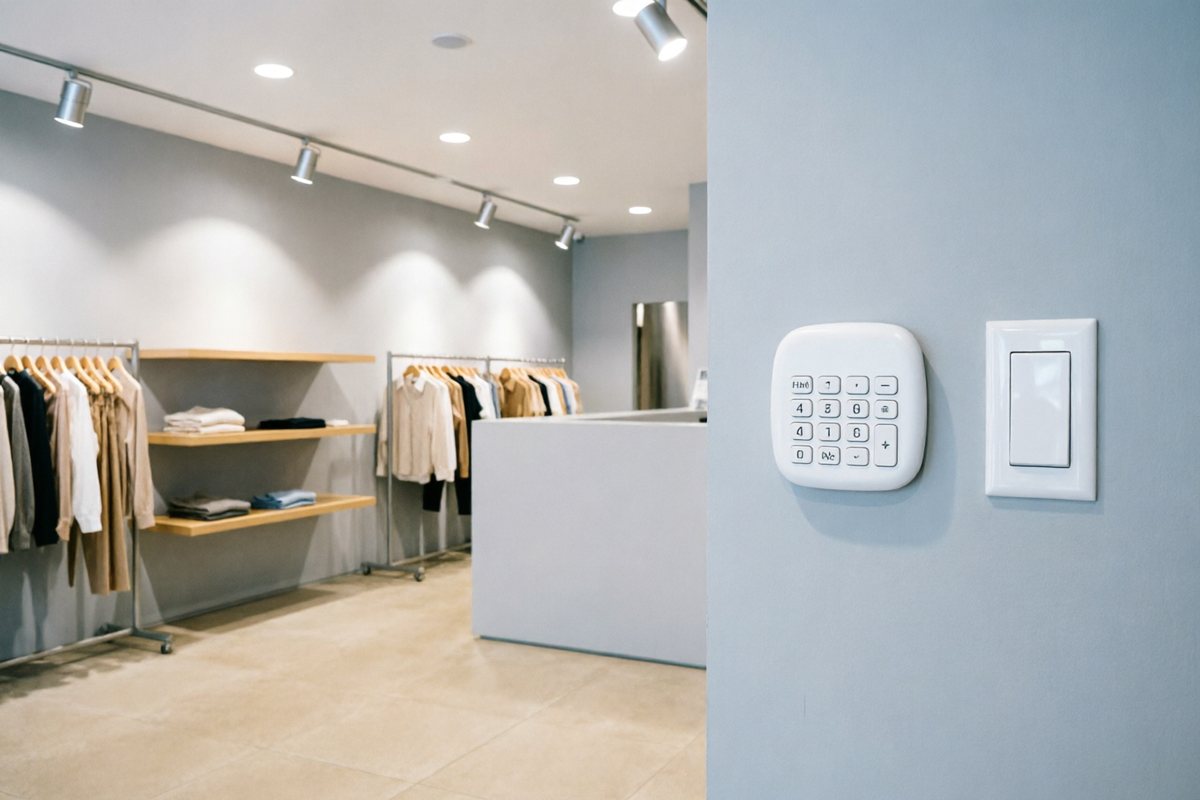
Switches, sockets and one standard gateway per branch, with opening and closing scenes tied to trading hours — a chain rollout that keeps training, spares and the energy bill identical across doors.

| Buyer type | Chain facilities teams, shopfitters, SME owners, franchise operators |
|---|---|
| Scope per branch | Switches · sockets (metering optional) · one standard gateway · opening / closing scenes · spare kit |
| Plate options | Local plate per market (86 / EU / UK / US) — one SKU sheet per country |
| Protocol lean | Wi-Fi or one standard gateway per branch — decided once for the chain |
| Scene logic | Open / Close tied to trading hours; All-Off as the end-of-day habit |
| Cert hooks | CE / UKCA / FCC / SASO and others, confirmed per SKU against each market |
| Quote basis | Branch count × per-branch kit, pilot first then rollout |
Branch-by-branch improvisation is the expensive option — the package replaces it with a standard that survives the border and the staff rotation.
Each branch electrician buys locally, and soon no spare fits any other branch. One SKU sheet per market ends the drift — the economics of that standardisation are the subject of the retail control guide.
Closing routines depend on who locks up. Opening and closing scenes tied to trading hours make the end-of-day All-Off a one-press habit instead of a checklist nobody finishes — restaurants run the same logic per the hospitality scenes guide.
Different panels per branch mean every transfer re-learns the wall. Identical kits per branch type mean staff training happens once for the chain, not once per door.
SME energy audits stall when nothing can be measured per circuit. Metering socket variants on named loads give the audit numbers without a building-management project.
Mall units arrive with back-box depths and isolation rules you do not control. The RFQ carries the site constraints so plate depth and wiring forms are speced per site — not discovered by the shopfitting crew.
Branch types (flagship / standard / kiosk) take scaled versions of the same sheet. Final mix follows branch count, markets and trading-hours logic in your RFQ.
| Component | Reference SKU & spec starting point | Install & wiring | Why it matters |
|---|---|---|---|
| Wall switches | PL-SW-T3-WIFI-86 class / local plate · 1-4 gang by branch type | Standard back box, same positions every branch | Identical walls across doors keep training and photosets consistent |
| Sockets, incl. metering | PL-SK-IW-US class / local plate · metering variants on named loads | Per electrical layout | Sockets and switches from one frame family; metering feeds the energy audit |
| Standard gateway | PL-GW-ZB-MTR · one per branch, same model chain-wide | Back office, Ethernet | Schedules and scenes stay identical everywhere; one spare model chain-wide |
| Opening / closing scenes | Open / Close / All-Off legends as OEM print | Configured at install, tied to trading hours | Trading-hours logic lives in one documented routine staff can actually run |
| Per-branch spare kit | Percentage against branch kit, agreed in RFQ | Held at the regional depot | A failed panel swaps in hours from the same batch, not weeks from a new order |
The pilot validates install depth, schedule behaviour and staff routine. The SKU sheet is corrected once, then every branch orders the same list — no per-door redesign.
Each branch ships as one kit line with its spare percentage, so receiving, install and claims all reference one packing list. Kits arrive carton-marked per branch.
The Open / Close / All-Off logic ships as a one-page routine per branch type, printed in the brand's language set through the OEM documentation flow — staff follow it from day one.
MOQ moves with plate standard, metering variants and print scope. State branch counts and markets in your RFQ; our trading desk confirms factory-level MOQ in the reply based on final spec and destination market.
Pilot units and rollout production dates are quoted against the corrected SKU sheet — cert packs per market sit on the critical path. Confirm both windows in the RFQ against the store-opening calendar.
40+ partner factories · 8,000+ product SKUs · 50+ export markets · 95% on-time shipment · 12 years in export. One desk consolidates multi-factory lines into one packing list per shipment.
Send branch counts by branch type, markets, plate standards, trading-hours logic and any metering needs. The reply returns a per-branch kit structure with a pilot-first plan — priced on final spec.
One standard gateway per branch is the usual pattern for chains, because it keeps schedules, scenes and spares identical everywhere. Single small shops can run hub-free Wi-Fi. State branch size and IT policy in the RFQ and the desk quotes the matching structure.
Schedules live in the app layer and re-sync after power returns; the wall switches keep working as normal switches in the meantime. Critical loads should stay on manual or dry-contact control regardless of any schedule.
Plate and cert standard follow each destination market, while the frame family and SKU logic stay the same. The SKU sheet is written per market so the chain standard survives the border — see the cert capability map.
One to three branches is the useful pilot: enough to test install, schedule behaviour and staff routine, small enough to correct the SKU sheet before the chain order. Exact quantities are confirmed in the RFQ on final spec.