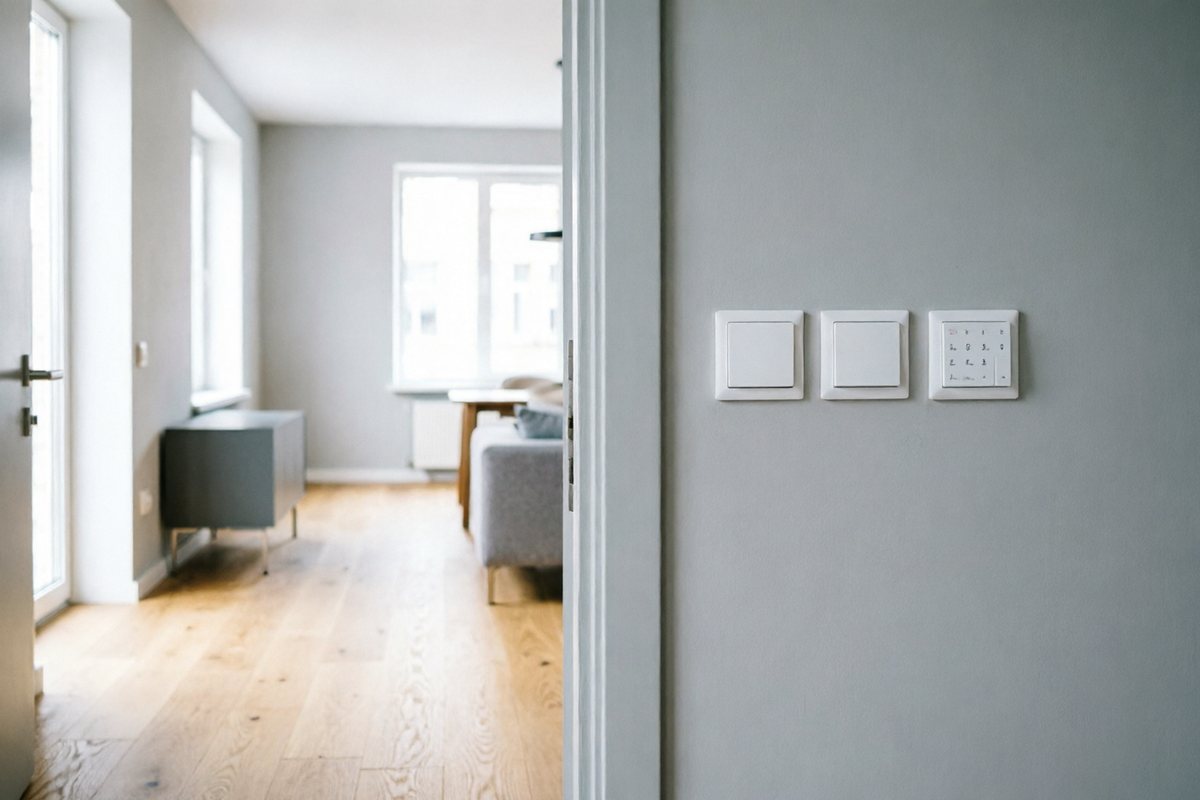
Unified frames, locked colourway, printed room labeling and per-tower carton marks — batch wall control that survives phase two without a visible colour line between buildings.

| Buyer type | Property developers, fit-out contractors, EPC contractors on residential blocks |
|---|---|
| Scope per unit | Switches by room-type BOM · sockets · optional hallway sensor · labeling per room |
| Plate options | 86-type · EU — one frame family across the whole project |
| Protocol lean | Wi-Fi or mixed per phase; gateway only where the programme demands central control |
| OEM focus | Locked colourway · room legends · language inserts · carton marks per tower / floor |
| Cert hooks | CE / UKCA / SASO and others, confirmed per SKU against destination market |
| Quote basis | Unit count by unit type × phase |
Batch projects fail on consistency and logistics long before anyone tests a switch — so that is where this package locks things down.
Glass ordered months apart drifts in colour and finish; tenants see the line between towers. The colourway and glass batch are locked in the OEM brief and re-checked against the retained reference before each phase releases — see the colour and finish guide.
Procuring per flat produces hundreds of near-identical orders and a snag list nobody owns. The package reduces the project to room-type BOMs multiplied by unit count — a handful of SKUs, repeated cleanly, as argued in the standardisation guide.
Unmarked boxes slow electricians and put tower A panels in tower B. Cartons carry tower / floor / unit-type marks in the same print pass as the glass, so site crews sort by label, not by opening boxes.
Generic or mismatched tenant-facing legends grow the snag list at handover inspection. Legends and language inserts are approved at mock-up stage per market — the checklist lives on the OEM page.
Without an agreed spare kit, the property manager hunts discontinued SKUs two years later. The handover spare percentage is quoted as a package line, held against the locked batch.
Room-type BOMs (studio / 1-bed / 2-bed) multiply by unit count per phase. Final mix follows the wiring plan and labeling brief.
| Component | Reference SKU & spec starting point | Install & wiring | Why it matters |
|---|---|---|---|
| Wall switches, unified family | PL-SW-T family · 86 / EU plate · one glass colourway across the project | Standard back box, per room-type plan | One family means one spare pool, one training sheet, one visual identity per block |
| Sockets | Matching plate family, metering variants where the energy audit needs them | Per electrical layout | Sockets and switches from one frame keep the walls coherent at handover viewing |
| Room labeling | Printed legends per room · language inserts · OEM art | Applied at factory, approved at mock-up | Tenant-facing walls pass inspection without a second print run |
| Carton marks | Tower / floor / unit-type print on each carton | Same print pass as glass art | Site crews distribute by label — fewer wrong-unit installs and re-visits |
| Handover spare kit | Percentage against unit count, agreed in RFQ | Shipped with the final phase | Year-two replacements come from the locked batch, not from retail |
The retained reference from phase one gates phase two release. Colour, finish and glass batch are verified per production run — the mechanism is written into the RFQ reply, not assumed.
Room-type BOMs are frozen once and reused per phase. Quantities per SKU stay clean, and cert documents attach per family instead of per flat — the structure mirrors the hotel kit detail.
Cartons arrive marked tower / floor / unit-type with bulk packing for site distribution. Mock-up units validate legends and marks before the first phase releases.
Batch MOQ depends on frame family, colourway lock and print scope. State unit counts per phase in your RFQ; our trading desk confirms factory-level MOQ in the reply based on final spec and destination market.
Production windows are quoted against your phase plan — colour lock, art approval and cert pack each sit on the critical path. Confirm the windows per phase in the RFQ and plan handover dates against them.
40+ partner factories · 8,000+ product SKUs · 50+ export markets · 95% on-time shipment · 12 years in export. One desk consolidates multi-factory lines into one packing list per shipment.
Send unit types, unit counts per phase, plate standard, colourway intent and labeling languages. The reply returns a room-type BOM structure with batch-lock terms — priced on final spec.
Colourway and glass batch are locked in the OEM brief, and each later phase is checked against the retained reference before release. Batch alignment is a process commitment confirmed in the RFQ reply, not a catalogue claim.
It can, but it should not. The package pushes unit types to a small set of room-type BOMs so procurement manages a handful of SKUs instead of one order per flat. Genuine one-offs remain possible and are priced accordingly.
Printed legends per room, language insert cards, or full OEM art on glass. All labeling art is approved at mock-up stage together with carton marks, so nothing reaches mass print unapproved.
Yes, as a quoted package line: a spare percentage against unit count, agreed in the RFQ and shipped with the final phase. The property manager then draws from the locked batch instead of hunting retail substitutes.