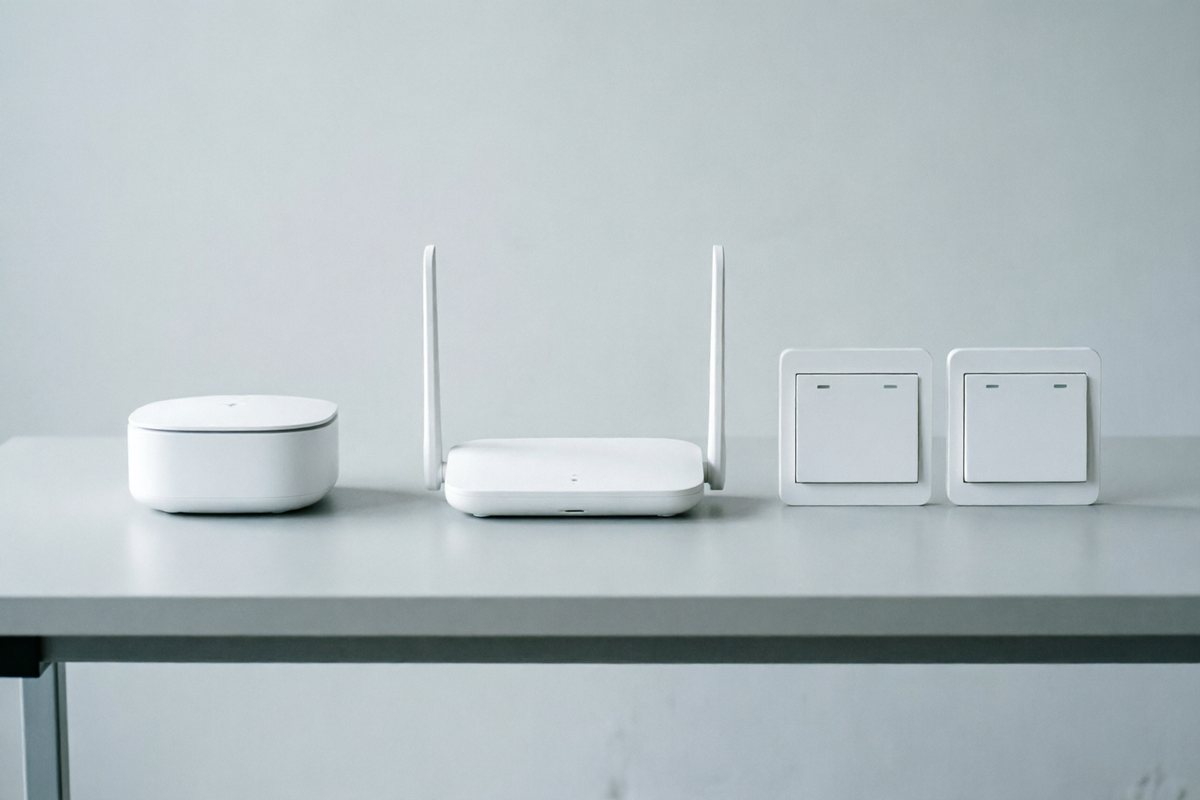
Among the protocols a smart wall switch can speak, Z-Wave occupies a distinctive position: older and more tightly governed than Wi-Fi, hub-dependent by design, and running in sub-GHz spectrum rather than the crowded 2.4 GHz band. For a segment of the market — particularly in North America, and particularly where security-grade reliability and dealer-driven installs matter — that position keeps Z-Wave on RFQ shortlists in 2026 even as Matter and Zigbee take most of the headlines. This overview is written for B2B buyers considering Z-Wave touch panel switches as a product line: what the ecosystem is, how its wall panels behave in practice, what the product landscape looks like, and which questions separate a usable Z-Wave SKU from a shelf-warmer. It is deliberately neutral — a positioning brief, not a promotion.
What the Z-Wave ecosystem is
Z-Wave is a wireless protocol purpose-built for home control, developed and maintained under the Z-Wave Alliance, with certified products across lighting, locks, sensors and controllers. Its defining technical traits are stable and public: it operates in sub-GHz radio bands, with the exact frequency varying by region, which keeps it clear of the Wi-Fi congestion that affects 2.4 GHz protocols; it forms a mesh network in which mains-powered devices such as wall switches relay traffic for battery devices; and it is hub-centric — a controller or gateway coordinates the network, rather than each device joining a home router directly. Z-Wave Long Range extends reach beyond the classic mesh for larger properties. Devices carry the Alliance's certification, and the S2 security framework is part of the ecosystem's identity. The practical meaning for a buyer is that Z-Wave trades openness for discipline: fewer device categories and a certification gate, in exchange for behaviour that is comparatively predictable across brands.
How touch panel switches fit the ecosystem
Within Z-Wave, wall panels occupy two roles. Most commonly, a Z-Wave touch switch is a controllable load device: each gang is an endpoint the hub can switch, automate and include in scenes, while the glass face provides local control and backlit state indication. Some glass panels also act as scene controllers — buttons that do not switch their own load but send scene activations to the hub, useful where a central panel coordinates rooms already wired through other means. Behaviour buyers should probe when sampling: inclusion and exclusion procedure (how reliably a technician can add the device), association group flexibility (which devices can be triggered without the hub in the loop), response latency for local presses, and whether the panel exposes clear state feedback when the hub — not the user — changes a load. These behaviours, not the radio itself, are where Z-Wave panel quality actually differentiates between factories; each should be confirmed on samples, in writing, before volume.
The product landscape, described neutrally
Z-Wave touch panels are a mature category with several established specialist brands. MCO Home is widely known for glass touch wall panels in the Z-Wave ecosystem; Aeotec, Fibaro, HomeSeer and Zooz are among the other names long associated with Z-Wave wall control products, each with their own panel and switch families. These mentions are existence-level context, not endorsements — parameter sets, firmware practices and regional availability differ across brands and should be verified per product. On the supply side, Z-Wave wall products are manufactured substantially in the same Chinese clusters as other smart switch categories, with Guangdong and Zhejiang being the two major manufacturing regions for the category. For buyers assembling a multi-protocol line card, the sensible framing is: the Z-Wave shelf exists, it is populated by specialist brands with long histories, and the open question for any new entrant is not whether products exist but which factory partnership and certification path fits their own programme.
Z-Wave alongside Matter and Zigbee
Buyers naturally ask where Z-Wave sits against the protocols with louder 2026 momentum. The verified headline numbers belong to the competitors: Matter has passed 4,000+ certified devices with version 1.6 released in June 2026 and backing from Apple, Google, Amazon and Samsung — support covering more than 95% of the voice-assistant market — while Zigbee counts 3,500+ certified products and a Zigbee 4.0 revision with sub-GHz support expected in the second half of 2026. Z-Wave's counterweights are different in kind rather than degree: sub-GHz operation that sidesteps 2.4 GHz congestion, a certification regime that constrains how much devices can differ, and an installed dealer base in security-adjacent and retrofit-heavy channels. None of these traits makes Z-Wave "better"; they make it different. A portfolio decision should follow the destination market's ecosystem habits — which hubs customers already own, which installer channels sell the product — rather than protocol press coverage. Our protocols page frames the full comparison, and the deeper Wi-Fi versus Zigbee trade-offs are in this dedicated comparison.
Who still specifies Z-Wave, and why
In current practice, Z-Wave shortlists tend to come from three buyer profiles. Distributors serving North American retrofit and DIY-adjacent retail, where established hub ecosystems and brand familiarity create pull. Security and professional-install channels, where the protocol's long history in monitored-home systems keeps it on specification. And multi-protocol brands that want a sub-GHz option on the line card for customers reporting congestion problems in dense housing. What these profiles share is that the protocol choice is driven by the channel, not the device: the touch panel itself — glass face, gangs, backlighting, legends — is nearly identical across protocols, and it is the ecosystem behind it that differs. That is also why the manufacturing side matters less than the module and certification side when sourcing Z-Wave: the factory's Z-Wave module partner and certification history deserve more scrutiny than its glass-cutting capability.
What to confirm in a Z-Wave panel RFQ
- Exact Z-Wave platform generation and frequency variant for each destination market, stated by the supplier in writing.
- Certification status of the specific panel, not just the module — and which certificate documents can be reviewed before order.
- Device class behaviour: load-switching endpoints versus scene-controller roles, per gang.
- Inclusion/exclusion workflow, association groups, and behaviour when the hub is offline.
- S2 security implementation and firmware update mechanism, including who controls updates.
- Panel hardware items as with any touch panel: gangs, backlighting, legends, face material and packaging.
As a trading platform with 40+ partner factories, 8000+ SKUs and 12 years of export experience, we treat protocol lines exactly this way: the ecosystem is the buyer's strategic decision, and our desk's job is to surface the factories, certification evidence and sample behaviour needed to execute it. Related reading: where Z-Wave wins in practice is examined in this 2026 positioning piece, and the commercial-project angle across ecosystems is compared in Control4, Tuya and KNX. For any protocol, state the requirement once in the RFQ and let the desk return certified options.
Evaluating a Z-Wave panel line?
Tell us the destination markets and hub targets — we will propose certified panel options with platform details and certificates confirmed in writing before you sample.
Start RFQ