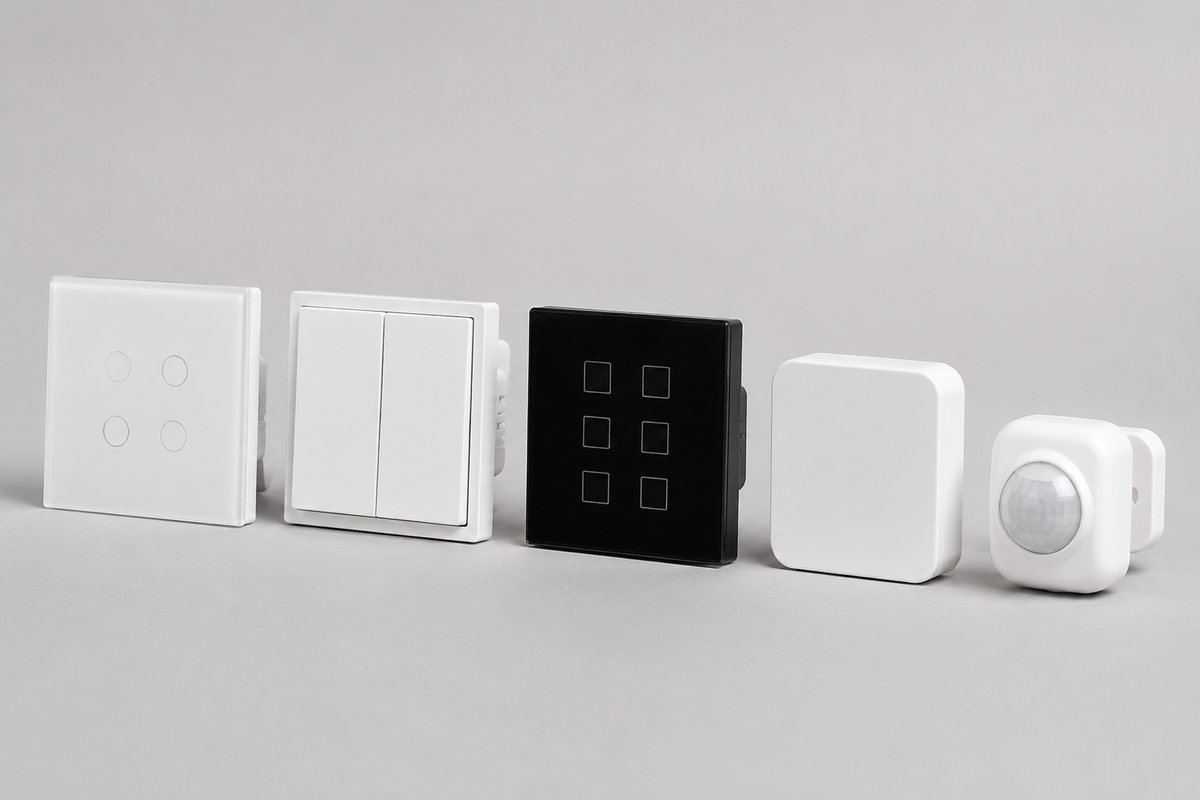
The smart touch panel switch shelf now carries names from several different worlds: long-established electrical manufacturers, smart-home specialists that grew up alongside the app economy, and factory lines that fill catalogues under other companies' logos. For a B2B buyer — a distributor, an integrator, or a private-label brand — the useful question is not "which brand is best" but "how is this landscape structured, and where does my business model fit into it". This overview is deliberately brand-neutral. It describes who exists and how the market is organized, without rating any company, because sourcing decisions made on shelf recognition alone are how buyers end up with a supply chain that does not match their market.
A growing category that is not yet consolidated
The wider smart home market was estimated at roughly USD 180 billion in 2026, with projections approaching USD 850 billion by 2034, and wall-mounted control devices are one of the categories riding that growth. Despite the momentum, the touch panel switch segment remains fragmented. No single brand dominates global distribution, and regional shelves differ meaningfully: a buyer reviewing catalogues in Europe, North America, the Gulf, and Southeast Asia will find overlapping but not identical sets of names. For B2B buyers this fragmentation cuts both ways. It is a risk, because consistency and support levels vary widely between sellers. It is also an opportunity, because categories that have not yet consolidated leave room for regional brands, project suppliers, and private labels to compete on distribution, service, and specification rather than on brand heritage alone.
Three layers of the brand landscape
It helps to see the market as three stacked layers rather than a single list of competitors.
- Established electrical brands. Companies whose core business is wiring devices, circuit protection and related electrical infrastructure. Many have added connected switches as an extension of existing ranges, typically distributed through the same electrical wholesale channels as their conventional products.
- Smart-home-first specialists. Companies founded around connected devices, for which glass touch panels, scene control and app ecosystems are the core product rather than an add-on. These brands often lead on protocol breadth and design-led ranges.
- Factory and OEM supply. The manufacturing layer that builds for its own labels and for other companies' brands. Production of smart switches and panels is concentrated in two Chinese clusters: Guangdong (Shenzhen, Dongguan) and Zhejiang (Wenzhou and surroundings). Tuya is one of the mainstream OEM/ODM ecosystems many of these factories build on, alongside factories running their own firmware stacks.
The same physical product can appear under all three layers, because branded lines are frequently manufactured by contract factories in the same clusters as unbranded ones. That overlap is the single most important structural fact in this market.
Names you will encounter
In catalogue reviews, RFQ responses and trade-show aisles, buyers of touch panel switches will repeatedly come across names such as MCO Home, Heltun, Aeotec and GE Enbrighten, alongside app-ecosystem brands and regional wiring-device companies. MCO Home and Heltun are commonly listed among the specialist makers of wall panels in the Z-Wave and multi-protocol space; Aeotec builds devices that bridge into several ecosystems; GE Enbrighten appears on connected switch lines sold through North American retail channels. Naming them here is descriptive, not comparative. Availability, protocol support, certification coverage and specifications differ by model and by market, and nothing in this article should be read as an endorsement, a ranking, or a claim about any brand's parameters. If one of these names is on your shortlist, the correct next step is the same as for any unknown name: request the datasheet, the test reports and the certification documents for the exact SKU you intend to buy.
What a brand name does and does not tell you
Brand names compress information, which is exactly why buyers reach for them. A known brand tells you that someone has invested in distribution, packaging and a consistent level of quality control. It does not tell you who physically manufactured the unit, whether that specific SKU matches your market's voltage, wiring conventions and certification requirements, or what after-sales terms apply to a commercial project rather than a retail consumer. Conversely, an unfamiliar name does not imply low quality — it often means the seller is a factory trading under minimal branding or a young private label that has not yet built retail recognition. The dependable shortcut in this market is documentation rather than recognition: a supplier who can produce a coherent set of datasheets, test reports and certificates for the exact SKU is telling you something a logo cannot.
Branded purchasing vs. OEM sourcing
B2B buyers effectively face two paths into this landscape. Buying branded stock suits distributors who need fast availability, retail-ready packaging and a warranty story attached to a familiar name — accepting in exchange the margin structure, MOQ terms and limited customization that brand ownership imposes. OEM/ODM sourcing suits importers, project suppliers and integrators who can absorb a longer path to market and some specification work, in exchange for control over logo, packaging, app branding, firmware direction and cost. Most buyers arriving at a trading platform sit closer to the second path. For them, the brand landscape matters mainly as a benchmark: you study what established names offer on the shelf, then decide which of those attributes your own OEM specification needs to match, and which you can deliberately drop to hit a price point. Our OEM/ODM page describes how that process is structured, and the product catalogue shows the platform SKUs that OEM programs typically start from.
How to evaluate a supplier when brand is not the filter
When you source unbranded or own-brand product, the evaluation checklist replaces the brand shortcut:
- Certification evidence for your destination market, with report numbers you can verify against the issuing lab, not only a certificate cover page.
- Written protocol specification — which module, which firmware revision, which app, and what the Matter or bridge path is, if claimed.
- Sample-first testing against your actual wiring, wall boxes and network conditions before any bulk commitment.
- Documented export experience to your region, including packing standards and container consolidation practice.
- Warranty and spare-parts terms defined in the contract, including what happens to a batch that fails on site.
Certification evidence deserves particular weight, because it is the item buyers most often assume rather than verify. Our certifications page lists what to request per market.
What to put in the RFQ
Whether you are benchmarking against shelf brands or building your own line, an RFQ that states the destination market and voltage, the protocol and app ecosystem, the plate format and gang configuration, the certification requirement, and the packaging or branding expectation will get you comparable quotes instead of a pile of different products that happen to look similar on paper.
Benchmarking brands or building your own line?
Send one RFQ with your destination market, protocol and branding requirements, and we will come back with matched options across factories.
Start RFQ